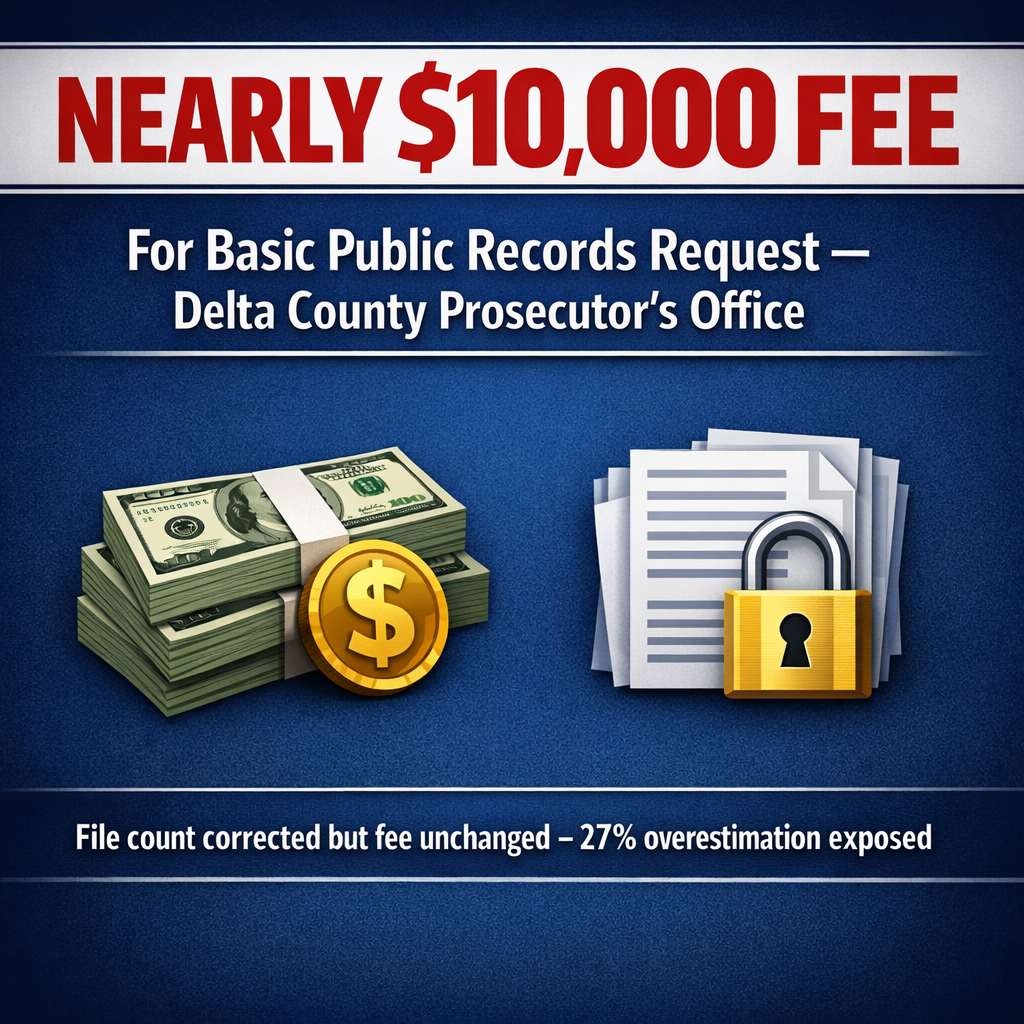
FOIA Request #26-21: $9,956 Fee to Access Public Conviction Statistics – Amended Response Reveals Data Inconsistencies
Date: February 12, 2026
Status: Denied with Excessive Fee Estimate
Requested: Aggregate criminal conviction totals (2023-2025)
View FOIA and Responsive document here -> 26-21 AMENDED Response
The Request
On January 21, 2026, I submitted a straightforward FOIA request to the Delta County Prosecutor’s Office seeking basic public information: the total number of criminal convictions obtained by the office from January 1, 2023 through December 31, 2025. This three-year aggregate is exactly the type of fundamental performance data that any public prosecutor should be able to provide without significant effort – it’s a single number that reflects their core function.
Instead of transparency, I received two responses that together reveal significant problems with how the Delta County Prosecutor’s Office handles public records requests.
Initial Denial: February 5, 2026
The first response, dated February 5, 2026, denied my request in a manner that has become familiar in my interactions with this office. Prosecutorial Assistant Lisa M. Karpel claimed:
“Your request for an aggregate total of the number of criminal convictions from January 1, 2023 through December 31, 2025 is denied because this aggregate total does not exist.”
This is the same “aggregate doesn’t exist” argument I’ve now seen used across multiple FOIA requests – #25-132, #25-131, and #26-20. The office consistently claims that while they have the underlying individual case files, they’re not required to compile or aggregate information from those files unless I’m willing to pay substantial fees.
The initial response estimated that fulfilling my request would require reviewing approximately 1,500 files per year (4,500 files total over three years). Based on this estimate, they calculated a fee of $9,956 and provided a timeline of 270 days – essentially nine months to provide what should be basic statistical data. They demanded a 50% deposit of $4,778 before beginning any work.
The Amended Response: February 12, 2026
Just seven days after the initial denial, I received an amended response. This second document, dated February 12, 2026, maintained the same denial rationale but contained a significant correction to the estimated workload:
The amended response now stated that reviewing the files would require approximately 1,100 files per year (3,300 files total over three years) – a reduction of 400 files per year, or a 27% decrease in the estimated work.
Here’s where things become problematic: despite reducing the estimated file count by nearly 30%, the estimated fee remained exactly the same at $9,956. The 270-day timeline and $4,778 deposit requirement were also unchanged.
Why Was an Amended Version Sent?
The amended response was almost certainly sent because someone within the Prosecutor’s Office realized the initial 1,500 files-per-year estimate was substantially inflated. When a government agency makes an error in a FOIA response, they have an ethical and legal obligation to correct it. The fact that they voluntarily sent an amendment suggests the error was significant enough that they couldn’t justify it.
However, this correction actually raises more questions than it answers:
- How was the initial estimate of 1,500 files per year calculated? Did someone simply guess, or was there actual data behind this number?
- Why did it take a week to “discover” this error? The initial response was prepared and reviewed before being sent. A 27% overestimation is not a minor clerical error – it suggests either incompetence or deliberate inflation of the estimated workload.
- Why wasn’t the fee recalculated? If the work decreased by 27%, the fee should have decreased proportionally. The fact that it remained exactly the same at $9,956 suggests that either:
- The fee calculation was never based on actual labor costs to begin with
- The fee was always intended as a deterrent rather than a good-faith estimate
- The office is charging for work they don’t actually intend to perform
- Which number is correct? Should we trust the initial 1,500 or the amended 1,100? And if the office was wrong once, could they be wrong again?
The $9,956 Fee Barrier
Let’s examine what $9,956 actually represents in terms of labor costs. The response doesn’t provide a detailed breakdown, but Michigan FOIA fee regulations typically charge for:
- Labor costs for searching, locating, and examining records (actual hourly wage of the lowest-paid employee capable of performing the task, plus fringe benefits)
- Costs for duplication (typically $0.10 per page for copies)
Even if we assume that reviewing 3,300 files (the amended estimate) requires actual examination of each file and that this work is performed by a relatively low-paid clerk earning $20 per hour (including benefits), the math doesn’t support a $9,956 fee:
- 3,300 files ÷ $20/hour = 498 hours of labor
- At a 40-hour work week, that’s 12.5 weeks of full-time work
This is patently absurd for simply identifying which files resulted in convictions. These are the Prosecutor’s own case files – they should be organized, indexed, and easily searchable. A competent prosecutor’s office should be able to run a database query or perform a systematic file review in a fraction of this time.
The fee is clearly designed to discourage the request, not to recover actual costs. This is a common tactic called “fee harassment” – setting fees so high that no reasonable person can afford them, effectively denying access to public information without technically denying the request.
Broader Pattern of Obstruction
This request is part of a broader pattern I’ve documented in my interactions with the Delta County Prosecutor’s Office:
- FOIA #25-132: Parolee drug trafficking case – response provided, but case was dismissed and transferred to federal prosecution
- FOIA #25-131: Detroit-based drug trafficking – partial information provided, inconsistencies in disclosure
- FOIA #25-130: UPSET bar raid – response provided, but took two separate documents
- FOIA #25-234: Lab results from cocaine raid – laboratory reports provided, but correspondence documents denied
- FOIA #26-20: Criminal case statistics – denied using Densmore precedent for “duplicate requests”
- FOIA #26-21: Criminal conviction totals – denied with excessive fee estimate, then amended with unexplained fee inconsistency
Across these six requests, I’ve seen:
- Inconsistent information disclosure (some files provided, others withheld without clear justification)
- Repeated use of legal technicalities to deny legitimate requests
- Fee structures designed to deter rather than facilitate access
- Apparent incompetence in estimating workloads (as demonstrated by the 27% correction in this request)
- Failure to maintain basic records (like aggregate statistics) that any well-run organization would track
The Fundamental Question
What does the Delta County Prosecutor’s Office have to hide?
The total number of criminal convictions is not sensitive information. It doesn’t reveal confidential investigative techniques, doesn’t endanger witnesses, doesn’t compromise ongoing cases, and doesn’t violate anyone’s privacy. It’s basic performance data that taxpayers have every right to know.
A prosecutor who is doing their job effectively should be proud to share their conviction numbers. A prosecutor who is struggling might be reluctant, but still has an obligation to transparency. The fact that this office is willing to charge nearly $10,000 and wait nine months to provide what should be simple statistics suggests deep-seated problems with either competence, accountability, or both.
Conclusion
FOIA Request #26-21 demonstrates two critical failures:
- Failure to maintain basic records: A properly run prosecutor’s office should have aggregate conviction statistics readily available, not buried in thousands of individual files that require months of review.
- Failure to provide accurate cost estimates: The discrepancy between the initial 1,500 files-per-year estimate and the amended 1,100 files-per-year estimate, combined with the unchanging $9,956 fee, suggests either incompetence or bad faith in the fee calculation process.
The amended response doesn’t fix the problem – it actually makes it worse. By revealing that the initial estimate was substantially inflated while maintaining the same high fee, the office has demonstrated that their fee structure is not based on actual costs but is instead an arbitrary barrier to transparency.
Michigan’s Freedom of Information Act was designed to promote government accountability, not to enable fee harassment and obstruction. The Delta County Prosecutor’s Office’s handling of this request violates both the letter and the spirit of the law.
Request Status: Denied
Documents Referenced
- Initial Response: #26-21.pdf (February 5, 2026)
- Amended Response: 26-21 AMENDED Response.pdf (February 12, 2026)
- Michigan Freedom of Information Act, MCL 15.231 et seq.
- Previous related FOIA requests: #25-132, #25-131, #25-130, #25-234, #26-20

Leave a comment