The TikTok That Started It
In the summer of 2023, the Delta County Sheriff's Office was working a homicide. The victim was a young woman. One of the detectives assigned to the case was Sergeant Thomas Vincent Lewis. Among the people he had interviewed was the victim's employer — a woman who managed a restaurant in Escanaba and who, by her own later account, had developed a friendly, flirting rapport with the sergeant over the course of the investigation.
On Sunday, July 16, 2023, the victim's TikTok account posted something that stopped people in the community. It was a photograph of the young woman with a caption that read, in part, that when she died she wanted to be tossed into the woods naked so she could “go back to the Earth & do something beautiful for the ecosystem.” A comment beneath it observed that the sentiment was illegal in Michigan. The post was dated 2022, but in the days after the murder it circulated again, and it circulated with a particular force for the people who had known her.
The witness saw it and sent it to Sergeant Lewis. What followed over the next several hours is preserved in three screenshots that the Sheriff's Office eventually produced under court order and that the Prosecutor's Office later released under the Freedom of Information Act. They are reproduced below exactly as they appear in the released records.
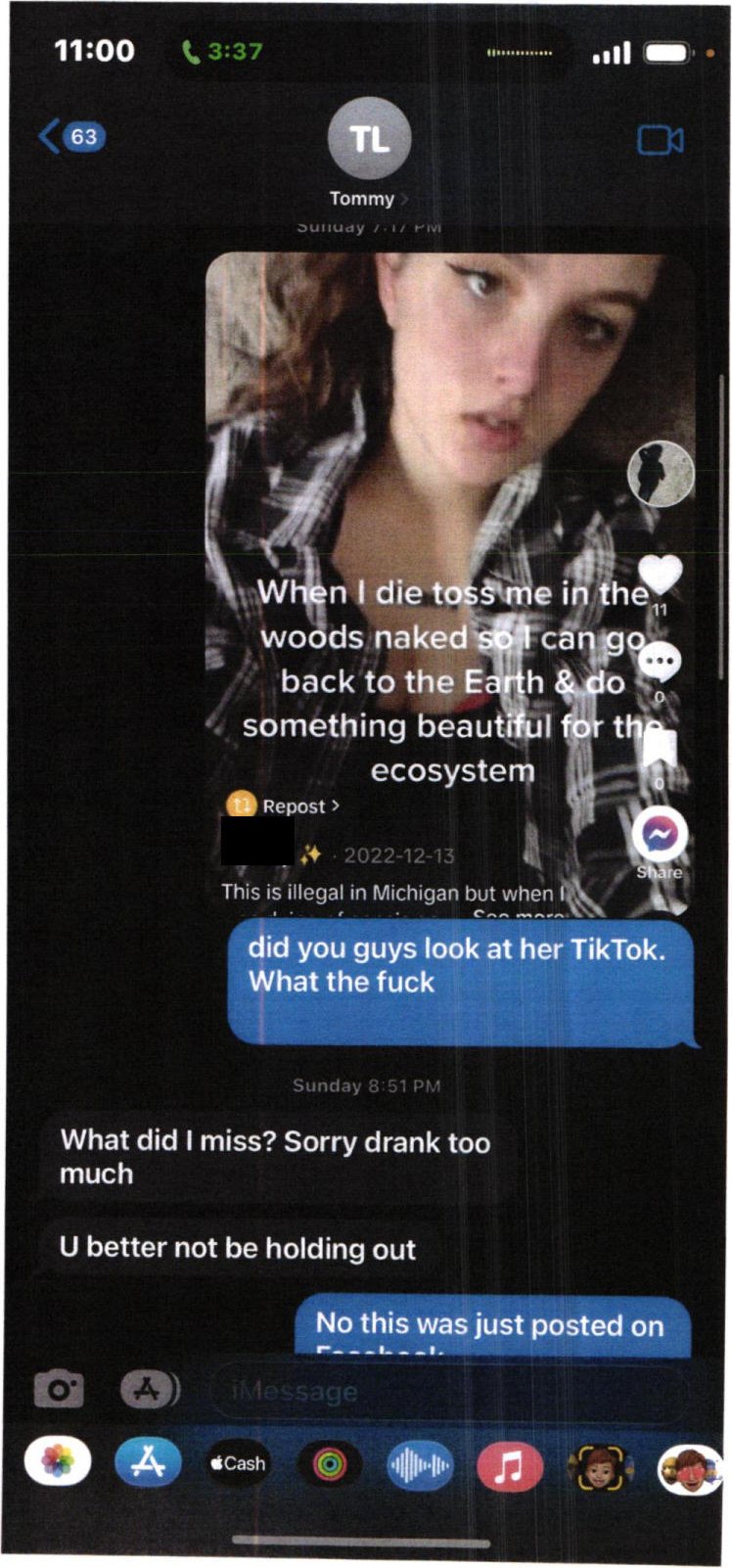
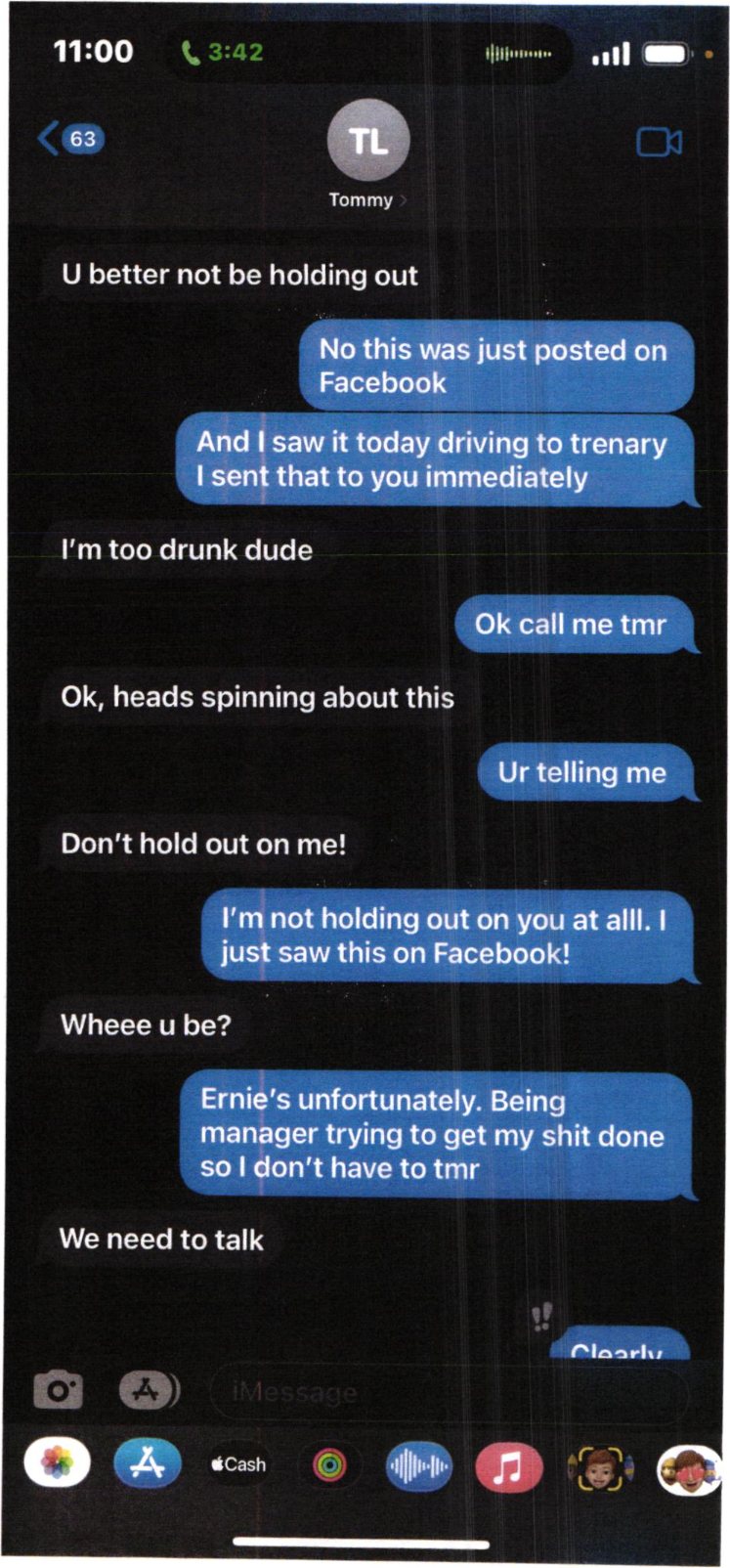
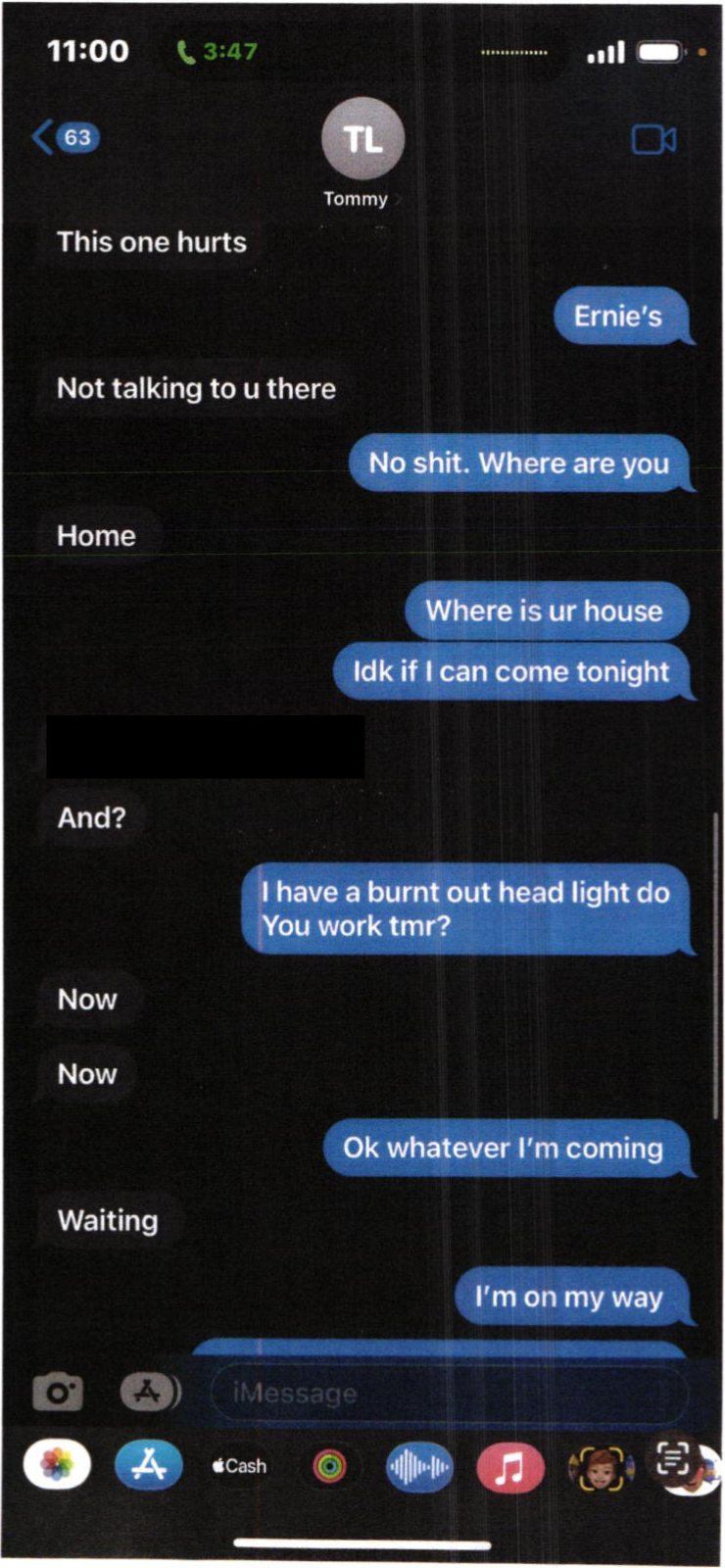
These three images are the evidentiary heart of this case watch. Everything that follows — the internal affairs inquiry, the state police investigation, the trial court's evidentiary ruling, the appellate reversal, and the fee dispute over the public records themselves — flows from what is visible on those screens.
Sunday, July 16, 2023
The chronology of that night is not speculation. It comes from a memorandum written by Undersheriff Phillip J. Griebel on August 21, 2023, after he interviewed the complainant and examined her phone. The memo is part of the record the Prosecutor's Office released in response to FOIA request 25-268. Its timeline is precise to the minute in places, and it is worth setting out in full.
Two things about this timeline matter. The first is that the Sheriff's Office knew within four days. The second is that the sergeant did not dispute the core of it. He admitted it, on the record, to the two highest-ranking officials in the department.
What the Messages Show
The screenshots are photographs of a phone screen, and they are imperfect. Some messages are cut off at the edges of the frame; the three images overlap and repeat a message or two where the witness scrolled. But the sequence is legible, and the alignment of the bubbles tells you who is speaking: the gray bubbles on the left are Sergeant Lewis, the colored bubbles on the right are the witness's own outgoing messages.
What the thread shows is a conversation that begins as an exchange about a dead woman's social media post and ends, a few hours later, with a woman driving to a sergeant's house at night with a burnt-out headlight while he tells her he is waiting.
“When I die toss me in the woods naked so I can go back to the Earth & do something beautiful for the ecosystem.”
And I saw it today driving to trenary I sent that to you immediately
Idk if I can come tonight
You work tmr?
Reading the Thread Carefully
Nothing in these screenshots is explicit. There is no threat spelled out, no proposition in so many words. What is there is a sergeant who says he is too drunk, a woman who says she does not know if she can come, and a man who answers “And?” and then “Now” and then “Waiting.” The context — that he was the lead investigator on a murder case in which she was a witness and the victim's employer — is not visible on the screen. It is the thing that makes the screen matter.
The Complaint
The complaint did not come from the witness directly. It arrived sideways, through someone else, and it arrived scared. On Thursday, July 20, 2023, at 2:42 in the afternoon, Sheriff Ed Oswald sent Undersheriff Griebel an email with the subject line “Complaint.” The email is short, and it is the first official document in the file.
“This came in through another person for her… she is really scared. This is only one side of the story, but I guess she has all the texts.”
Sheriff Ed Oswald to Undersheriff Phillip J. Griebel, July 20, 2023, 2:42 PMIn the same email the Sheriff summarized what he had been told: that a woman had texted Lewis about the murder investigation, that Lewis had admitted being home and having drunk too much, that he had wanted her to come to his house, that he had told her she had better not be holding back, and that he had then tried to get her to spend the night.
The witness had been scheduled to come in that Thursday. She cancelled. She came in the next day, Friday, July 21, 2023, and sat with the Undersheriff. She brought her phone. Griebel looked at it and confirmed that the number she had been texting belonged to Lewis's personal cell. A Delta County Sheriff's Office Citizen/Outside Agency Complaint Form was filled out — the form itself is largely blank in the released copy, with the date field reading “7 / 12/23” and the narrative captured instead in Griebel's memo.
Three days later, on Monday, July 24, Griebel and Oswald sat down with Sergeant Lewis. What happened in that room is the single most important sentence in the entire file.
The Sheriff's Own Memo
Undersheriff Griebel's memorandum of August 21, 2023 is a one-and-a-half page internal document. It was written a month after the interview, it was never released to the public until this FOIA, and it is the closest thing in the record to an official finding of fact about what happened.
It records that the complainant told him she had texted Lewis about the murder investigation beginning around 7:17 that Sunday evening; that Lewis told her he had been drinking and had too much to drive; that he asked her to come over; that he gave her his address around 9:44; that she arrived between 10:30 and 11:00 and stayed until about 12:45 in the morning.
It records that while she was there, Lewis kept telling her she had better not be holding out on him. And it records the thing that turned a late-night conversation into a complaint: she told the Undersheriff that it upset her that Lewis said he could get her in trouble for dealing cocaine in town if she was lying.
Then the memo turns to the interview with Lewis.
“[Sergeant Lewis] immediately admitted to having [the witness] at his house and said he never should have talked to her off duty, especially when he had been drinking.”
Undersheriff Phillip J. Griebel, memorandum dated August 21, 2023That is an admission, made to the Sheriff and the Undersheriff, that the sergeant had a civilian witness in a homicide case at his home, off duty, while drunk, after telling her not to hold out on him. The memo does not record him disputing any of it.
Griebel then went back to the witness and told her that Lewis had admitted everything and that he might be disciplined. That conversation is also in the memo, and it is the reason the witness believed, for the next eighteen months, that the matter had been handled.
What the Memo Does Not Say
The August 21 memo does not mention a kiss. It does not mention a request for sexual photographs. It does not mention that Lewis asked her to spend the night in the same paragraph as any physical contact. Those allegations exist in the file — but they enter the record later, from a different direction, and through a different door. That gap is the subject of Section 09.
Two Shifts
On September 6, 2023, Undersheriff Griebel wrote a second memorandum. It is four lines long. It is reproduced here in full.
“Sergeant Tom Lewis has been suspended without pay for two shifts. The days off will be September 11 and 12th.”
Undersheriff Phillip J. Griebel, memorandum dated September 6, 2023Two shifts. Not two weeks. Not a demotion, not a reassignment off the homicide case, not a referral for criminal review. Two working days, unpaid, in the second week of September 2023.
Whether that was the whole of the discipline is a question the records do not answer cleanly. In January 2024, the Assistant Attorney General prosecuting the murder case asked Griebel directly about it. Her email is in the released file, and so is his reply.
“When I spoke to Deputy Lewis he stated he was paid for the time he was off but the letter says he was not, which one is correct?”
“So there is no other report or anything that exists about the situation except what you sent?”
“He was not paid. I don't have any recording of the interview. I believe you have everything I sent the Attorney.”
So by the Sheriff's Office's own account, the discipline was two unpaid shifts, there was no recording of the administrative interview, and there was no other report. The entire institutional memory of a complaint that a sergeant had a drunk, off-duty encounter with a homicide witness consists of two short memos, a complaint form, and a handful of emails.
The State Police Investigation
The Michigan State Police investigation did not begin with the complaint. It began with the defense.
On December 4, 2023, Lieutenant Paul Campbell of the MSP Eighth District Headquarters met with defense attorneys representing Tavaris Lee Jackson Jr., the man accused of the murder. According to the MSP report — numbered 080-0000043-24, opened March 8, 2024, file class 73000, status OPEN — the defense alleged that Sergeant Thomas V. Lewis had been disciplined for misconduct in his official capacity, specifically for “extorting a witness” in the homicide investigation at his residence, and that a private investigator's information showed a “cover up of sexual allegations.” The report lists the offense as “MISCELLANEOUS CRIMINAL OFFENSE,” the venue as Delta County, and the date of the conduct as on or after Sunday, July 16, 2023, at 2300 hours.
The investigating members were Lieutenant Campbell and Sergeant James Wachnicki. The suspect is listed as Thomas Vincent Lewis, employer Delta County Sheriff's Office, with the notation “To be interviewed at later date.” Captain Green was advised.
Attached to the report are excerpts of emails from the defense, sent December 29, 2023, with additional content on January 30, 2024. They are the first documents in the entire file to allege a sexual dimension to what happened that night, and they say so bluntly.
“[The complaint] was more involved than the Sheriff documented in the report we obtained through FOIA. In that report there was no mention of any sexual component. In reality however, [the witness] told the Sheriff's Office that he kissed her and tried to get her to have sex with him. She refused and said she would call the police and have herself arrested before that. This is attempted CSC due to the position of authority and the coercion being applied to her while he was drunk and claiming to be investigating the homicide case.”
Defense correspondence summarized in MSP Report 080-0000043-24That paragraph is doing something unusual. It is the defense in a murder case telling the state police that the prosecution's own investigator committed a crime against a prosecution witness, and that the Sheriff's internal report omitted it. Whatever one thinks of the defense's motives — and they had every reason to want Sergeant Lewis impeached — the allegation had to be investigated on its merits. The MSP file shows that it was, and it shows what the investigation found.
The Witness, Interviewed
On February 29, 2024, the witness was interviewed by the Michigan State Police at the Gladstone Post. The supplemental report — Supplemental 0001, dated March 11, 2024 — runs five pages and is the most detailed account of that night anywhere in the record. It is also the document in which her credibility is most aggressively tested.
She told the troopers she had been the murder victim's boss at Ernie's. Lewis had interviewed her there and later returned with a search warrant. She had seen the TikTok, she said, and texted it to him. They had what she described as a friendship; she had flirted with him. The contact moved from Snapchat to text messages.
She also told them something that reframed the whole encounter. The summer before, Lewis had pulled her over for not stopping before the white line, and during that stop they had looked for cocaine in her car. More recently she had been stopped by MSP, by the Sheriff's Department, and by the city police. At one of those stops a straw tested positive for cocaine. She believed Lewis had something to do with the stops.
And she told them what he said at the house.
Her Account of the Threat
She said Lewis told her he was going to extort her for the cocaine. That, she said, is when she got angry and decided to tell. At his house he was drinking and offered her a Sprite — she thought it might have been Vernors. He repeatedly said she had better not be holding out on him. She felt bad for him. His house was gross. There were pictures of his girlfriend everywhere. He asked her to stay the night. She told him that if he did not let her leave she would get a domestic violence charge.
He said that if she was holding out he would get her in trouble for selling cocaine. She asked him: what are you going to have someone do a controlled buy on me?
She said they did kiss. He asked for a kiss and she accepted it. There was no other physical contact. She told the troopers it would have been fine up until what he said afterward.
She said she had been sober for four months, since the victim was murdered. She was not selling cocaine; she used recreationally. She reported the encounter about two weeks later, after her boyfriend called someone in law enforcement. She had deleted the conversation about a month after reporting but had screenshotted portions of it. And Lewis, she said, had sent her intimate pictures of himself — including some that day — and after she refused to stay he asked her to send some.
“In my defense I was scared as to what he may do to me if I didn't.”
The witness, interviewed by MSP, February 29, 2024She agreed to a phone analysis. Her phone was analyzed by the CCU on March 5, 2024, in Marquette, returned the next day, and she signed form UD-14B. That analysis is the pivot on which the case turns.
UNFOUNDED
On April 3, 2024, the Michigan State Police closed the investigation. Supplemental 0003 is two pages. It records that the phone extraction was completed and reviewed, and that it “did not provide any additional information related to Sgt. Lewis.” It records that a friend of the witness was interviewed on April 2, 2024, and had no knowledge of wrongdoing.
Then it states the finding, in capital letters, twice.
“UNFOUNDED, no evidence or corroborating information about wrong doing was located.”
MSP Supplemental 0003, April 3, 2024, Incident Status: UNFOUNDEDSet that beside what the Sheriff's Office had already concluded nine months earlier.
Lewis “immediately admitted” having the witness at his house and said he never should have talked to her off duty, especially when he had been drinking.
The complainant told the Undersheriff that Lewis said he could get her in trouble for dealing cocaine in town if she was lying.
“No evidence or corroborating information about wrong doing was located.”
Incident status: UNFOUNDED.
These two conclusions are not necessarily contradictory. An internal administrative matter and a criminal investigation ask different questions and apply different burdens. Conduct can be real, admitted, and disciplined without being criminal. That is a legitimate distinction, and it deserves to be stated plainly rather than treated as a cover-up.
But the distinction does not explain everything. The MSP file contains an admission by the subject of the investigation that he had a civilian witness in a homicide case at his home, off duty, while drinking, after telling her not to hold out on him. It contains a witness account of a threat to use a cocaine investigation against her. It contains a defense allegation of attempted criminal sexual conduct. And it closes with the words “no evidence or corroborating information about wrong doing was located.”
What the file does not contain is any record that Sergeant Lewis was ever interviewed. The report opened with the notation “To be interviewed at later date.” The closing supplemental does not say the interview happened. The Sheriff's Office told the Attorney General in January 2024 that there was no recording of its own administrative interview and no other report. If the state police never sat down with Lewis, then the investigation that found no evidence did not include the one step most likely to produce some.
The Judge's Order
While the state police were investigating, the murder case was moving toward trial. Tavaris Lee Jackson Jr. was charged in the 47th Circuit Court in Delta County with first-degree murder under MCL 750.316(1)(a), assault of a pregnant individual causing miscarriage or stillbirth under MCL 750.90a(b), and felony-firearm under MCL 750.227b. The case number was 23-011013-FC. The judge was the Honorable John B. Economopoulos.
The defense wanted to cross-examine Sergeant Lewis about the witness incident. On February 26, 2024, Judge Economopoulos signed an order that did two things. It denied the defense motion to exclude Life360 and Snapchat location data, holding the data admissible under MRE 803(6). And it ordered the Delta County Sheriff's Office to deliver sealed records to the judge's chambers by 4:00 p.m. on March 11, 2024, for in camera review.
The records the judge ordered produced were specific:
The Three Categories Ordered Produced
1. Sergeant Thomas Lewis's employment records.
2. Any communications between Sergeant Lewis and his employer, in any form — including memoranda, writings, or email — as part of his employment record.
3. Any text messages between Sergeant Lewis and the witness regarding her citizen complaint incident.
The order was emailed to Undersheriff Griebel on February 26, 2024, at 1:42 p.m. by Assistant Attorney General Caitlin Kirby, forwarded from the 47th Circuit Court Administrator. Two days later, on February 28, the witness sent Griebel the three screenshots. Griebel forwarded them to Kirby at 10:57 that morning with a note that has since become one of the more uncomfortable documents in the file.
“I reached out to [the witness] about the text messages per the judge's order. This is what she sent me today and this is how I remember the conversation when I met with her on her complaint.”
Undersheriff Griebel to AAG Caitlin Kirby, February 28, 2024, 10:57 AMTwo minutes later, Kirby replied.
“Just make sure there is a letter or a supplemental in the file you bring him that states you received those after the court order please!”
AAG Caitlin Kirby to Undersheriff Griebel, February 28, 2024, 10:59 AMGriebel answered at 11:06: “I will do that for sure.”
Read that exchange slowly. The Sheriff's Office had the complainant's phone in July 2023. Griebel had looked at the messages then. But the screenshots themselves did not enter the file until a circuit judge ordered them produced, seven months later. The prosecutor's office then asked for documentation establishing that they had arrived after the order — a paper trail of late arrival.
Whether that reflects diligence or something else is a judgment the reader can make. What is not in dispute is the sequence: complaint in July, discipline in September, order in February, screenshots in the file in late February, and a request that the file reflect that the screenshots came in only then.
The Court of Appeals
Judge Economopoulos barred the defense from cross-examining Sergeant Lewis about the witness incident at all. The defense appealed. On July 22, 2025, the Michigan Court of Appeals reversed, in an unpublished per curiam opinion, People of the State of Michigan v Tavaris Lee Jackson Jr., No. 371658, with Presiding Judge Feeney and Judges Borrello and Letica on the panel.
The opinion is worth reading closely, because it is the only neutral judicial body that has looked at this conduct and said what it means.
That sentence establishes the stakes. Lewis was not a peripheral figure. He was central to the investigation of the murder for which the defendant was on trial.
Pertinent. The Court did not say the allegations were proven. It said they were pertinent — that a jury was entitled to hear them and to decide what they were worth. That is the constitutional floor the trial court fell below.
That is the MRE 403 balance, and the Court resolved it against exclusion. Prejudicial, yes. Unfairly prejudicial, no. The distinction matters: evidence that makes a witness look bad is not the same as evidence that will cause a jury to decide the case on an improper basis. The Court held that the trial court abused its discretion and violated the Confrontation Clause by foreclosing the cross-examination entirely.
The Court cited People v Butler, 513 Mich 24 (2024); People v Biddles, 316 Mich App 148 (2016); People v Morton, 213 Mich App 331 (1995); People v Kelly, 231 Mich App 627 (1998); People v Spaulding, 332 Mich App 638 (2020); and People v Danto, 294 Mich App 596 (2011), and applied MRE 401, 402, 403, 404(b)(2), 608(b)(1), and 611(c). An earlier order in the same docket had been entered on November 4, 2024.
The Collision
By April 2024 the state police had called the conduct “unfounded.” By July 2025 the Court of Appeals had called the same conduct “pertinent” and held that a murder defendant had a constitutional right to put it before a jury. Both things are in the public record. The distance between them is the story of this case.
FOIA 25-268
The records in this story were obtained through Freedom of Information Act request 25-268, submitted to the Delta County Prosecutor's Office. The request was dated November 13, 2025, and faxed to the office at 10:33 that morning — five pages, received by the county's fax system and logged in the office's email.
The request asked for all records related to alleged misconduct by Sergeant Thomas Lewis occurring during, resulting from, or discovered in connection with his involvement in the homicide investigation under Case No. 23-011013-FC. It stated that it was based solely on the conduct described in the published Court of Appeals opinion of July 22, 2025, and that it sought only existing records. It then listed nine categories: the witness complaint and statements; internal affairs and professional standards records; the Michigan State Police investigation; communications between Lewis and the witness; communications within the agency about the misconduct; communications with prosecutors or the Attorney General; records of his role in the homicide investigation; body-worn camera, audio, photographs, and digital files; and personnel records related to the misconduct.
The office extended its response time the same day, invoking the “voluminous amount of separate and distinct public records” provision of the statute and setting a new deadline of December 5, 2025. That is exactly fifteen business days from November 13 — the five-day statutory period plus the ten-day extension — which means the extension consumed the entire allowance.
Responsive Records — 42 pages
Released: The DCSO Citizen/Outside Agency Complaint Form; Undersheriff Griebel's memoranda of August 21 and September 6, 2023; Sheriff Oswald's July 20, 2023 email; the Michigan State Police report 080-0000043-24 with its supplements; the February 26, 2024 circuit court order; the February 28, 2024 email chain transmitting the text messages; the January 2024 “RE: Lewis” email chain with the Attorney General's office; and the three text-message screenshots.
Result: RELEASED — with redactions.
Redactions and Withholding
Withheld: Names, contact information, dates of birth, and “personal information in the form of unsubstantiated allegations or unarrested conduct.” The office invoked MCL 15.243(1)(a) and MCL 15.243(1)(b)(iii), and on the denial form also MCL 15.243(1)(b)(i)–(iii) and MCL 15.243(1)(d), citing MCL 28.214 and MCL 780.311 for the video.
Result: DENIED IN PART — determination notice dated December 5, 2025.
Internal Affairs, MSP Communications, Prosecutor Communications
Certified as not existing: supplemental statements, notes, or clarifications from the complainant; internal affairs interviews and investigative notes; communications between MSP and the Sheriff's Office about the complaint; correspondence discussing Lewis's conduct with the witness; documents concerning his credibility, behavior, or fitness for duty; all communications between the agency and the Delta County Prosecutor's Office about the complaint, the conduct, his involvement, or his credibility; and any notes or reports on whether his conduct affected his investigative duties.
Result: “RECORD DOES NOT EXIST” on eight categories.
Body-Worn Camera and Reports
Quoted: $613.80 to review approximately 165 pages of reports and $810.04 to redact approximately 15 body camera videos totaling 10 hours and 12 minutes. A deposit of $306.90 was required before processing.
Result: FEE QUOTED — see Section 14.
The Documents Themselves
Everything described in this story comes out of one production. The Delta County Prosecutor's Office released it under FOIA 25-268 in a response letter dated November 5, 2025, and it arrived as two separate files: the office's own paperwork, and the records that paperwork was about. Both are reproduced below, page for page, so that a reader does not have to take any of the preceding twelve sections on faith.
The paperwork runs forty-one pages — the response letter, two completed fee worksheets, a video quote table, the denial and appeal forms, two copies of the statutory excerpt, the county's FOIA policy notice, the extension notice, and the fax receipt. The records themselves run forty-two scanned pages, which is the number the office's own fee estimate is built on: approximately 165 pages of reports and ten hours and twelve minutes of body camera video. Three of those forty-two pages are a verbatim repeat of the three text-message screenshots, so eighty pages appear below rather than eighty-three. Nothing has been reordered, condensed, or paraphrased.
No internal affairs file. No interview of Sergeant Lewis by anyone. No communication between the state police and the Sheriff's Office about the complaint or the finding. No correspondence about Lewis's conduct outside the two chains reproduced here. No credibility or fitness-for-duty assessment. No record of any communication between the Sheriff's Office and the Prosecutor's Office about the matter. And no notes on whether his conduct affected his investigative duties — the specific question the Court of Appeals held was pertinent to the defense. Each of those is a category the office certified as not existing, and each is a category a reader can now check against the documents rather than against the letter.
A note on what has been removed. The requester's name and fax number have been redacted, and so has the identity of the civilian complainant, whose name appears in several of the emails and in the state police reports. The office redacted her name in most places and left it in others; it is removed consistently here. Nothing else has been altered. The names of the public officials involved — the Sheriff, the Undersheriff, the sergeant, the Assistant Attorney General, the defense attorneys, and the judge — are left exactly as the records show them, because holding a public office is what makes their conduct a matter of public record.
The Price of Looking
The Freedom of Information Act permits a public body to charge for the cost of searching for, reviewing, and separating exempt from nonexempt material. It does not permit a public body to charge for the time it spends deciding whether to withhold something. The line between those two things is where fee disputes live, and the itemization in this file walks right up to it.
The office quoted two separate charges. The first covers the paper record.
The office explained the estimate this way: “it has taken staff approximately 45 minutes to review 5 pages of a report. This equates to approximately 9 minutes per page.” It also noted that “a jury trial is scheduled in this matter to commence in March 2026,” and gave a time frame of 30 days from deposit.
The second charge covers the video.
The office attached a video inventory. It is reproduced here in full, because the arithmetic of the quote depends on it and because 10 hours and 12 minutes is a great deal of footage for an encounter that lasted roughly two hours.
| Video | Duration | Hours (decimal) |
|---|---|---|
| V1 | 4:01 | 4.02 |
| V2 | 1:18 | 1.30 |
| V3 | 0:41 | 0.68 |
| V4 | 0:04 | 0.07 |
| V5 | 0:08 | 0.13 |
| V6 | 0:21 | 0.35 |
| V7 | 0:22 | 0.37 |
| V8 | 1:44 | 1.73 |
| V9 | 0:07 | 0.12 |
| V10 | 0:28 | 0.47 |
| V11 | 0:06 | 0.10 |
| V12 | 0:12 | 0.20 |
| V13 | 0:20 | 0.33 |
| V14 | 0:13 | 0.22 |
| V15 | 0:07 | 0.12 |
| Total | 10:12 | 10.20 |
The office also produced its wage worksheet for the sergeant's rate. It lists 15.93 total hours — the same 955 minutes billed for video review — a base wage of $538.95, workers' compensation at 4.02 percent ($24.94), FICA at 7.65 percent ($47.45), pension at 24 percent ($148.87), and medical at $9.63 per hour ($153.36), for a total amount with benefits of $994.89.
That worksheet total is higher than the $810.04 actually billed. The office charged less than its own worksheet. That is worth saying plainly, because it cuts against the easiest version of the story. Whatever else is true here, the video charge was not inflated relative to the office's internal math.
The combined quote was $1,423.84, with a good-faith deposit of $306.90 — half of the report estimate — required before any processing would begin. The request asked that the office notify the requester if anticipated fees would exceed $50 before processing. The office did.
The Timing Question
The office's own justification for the report fee was that “a jury trial is scheduled in this matter to commence in March 2026” — that is, that review would have to be done around a trial calendar. The fee quote is dated December 5, 2025. The Court of Appeals had reversed the evidentiary ruling four and a half months earlier, on July 22, 2025. The record does not show what happened to the trial date after the reversal.
The Records That Do Not Exist
The most consequential part of the response is not what the office released. It is what the office certified did not exist.
Under the Freedom of Information Act, a public body that does not possess a requested record must say so. It is a formal representation, made by the FOIA coordinator, that the record is not there. In this response, the office made that representation eight times.
Consider what that list means in combination. The Sheriff's Office conducted an internal inquiry into a complaint against a sergeant. The Undersheriff interviewed the complainant on July 21, 2023. He and the Sheriff interviewed the sergeant on July 24. A memorandum was written on August 21 and a discipline memorandum on September 6. And yet, according to the office's response, there are no internal affairs interview notes, no investigative notes, no supplemental statements from the complainant, and no record of whether the sergeant's conduct affected his investigative duties.
Two of these certifications are especially difficult to reconcile with the documents that were released.
The first is the claim that there are no communications between the agency and the Delta County Prosecutor's Office about the complaint, the conduct, his involvement, or his credibility. The released file includes a January 2024 email chain between Undersheriff Griebel and Assistant Attorney General Caitlin Kirby discussing precisely those subjects — whether Lewis was paid during his suspension, whether a recording of the interview existed, and whether any other report existed. The Attorney General's office is not the Prosecutor's office, and that distinction may be the whole answer. But the request asked for communications with the Attorney General's office as well, and the released emails are exactly that.
The second is the claim that there are no documents concerning concerns about his credibility, behavior, or fitness for duty. The February 26, 2024 order of the 47th Circuit Court required the Sheriff's Office to deliver Sergeant Lewis's employment records and all communications between Lewis and his employer to a judge for in camera review. Those records were ordered produced because a murder defendant's constitutional right to cross-examine depended on them. If they do not exist, the order had nothing to compel.
What “Does Not Exist” Actually Means Here
A “record does not exist” certification is not the same as a denial. A denial says: we have it, and we are withholding it under an exemption you can appeal. A no-record certification says: it was never created, or it is not in our custody. The second is much harder to challenge, because there is nothing to review. It is also the representation that a requester is least able to test from the outside.
What the Law Requires
The legal framework here has two halves: the exemptions the office invoked to withhold information, and the remedies the statute gives a requester when a withholding is wrong. Both are set out below.
MCL 15.243(1)(a) — Information of a personal nature
The office invoked this exemption, which permits withholding “information of a personal nature where the public disclosure of the information would constitute a clearly unwarranted invasion of an individual's privacy.” It was applied to names, contact information, dates of birth, and — in the office's own words — “personal information in the form of unsubstantiated allegations or unarrested conduct.”
Legal interpretation: The exemption protects personal privacy, not institutional embarrassment. Where the individual is a public employee acting in the course of his official duties, and where the conduct at issue has already been described in a published judicial opinion, the privacy interest is substantially diminished. The exemption also does not authorize withholding a record in its entirety when a redaction would suffice.
MCL 15.243(1)(b)(i)–(iii) — Law enforcement investigatory records
This exemption permits withholding investigatory records compiled for law enforcement purposes, but only to the extent that disclosure would interfere with law enforcement proceedings, deprive a person of a fair trial, or constitute an unwarranted invasion of personal privacy. The office cited subsections (i) through (iii).
Legal interpretation: The exemption is qualified, not absolute. It requires a specific, articulated harm tied to a specific record. A blanket invocation across an entire category of documents is generally insufficient, and the burden of justifying the withholding rests on the public body.
MCL 15.243(1)(d) — Other statutes incorporated by reference
The denial form cites this catch-all, which incorporates withholding required by other statutes, specifically naming MCL 28.214 (the Law Enforcement Information Network) and MCL 780.311 (the William Van Regenmorter Crime Victim's Rights Act) in connection with the video.
Legal interpretation: When a public body relies on an incorporating exemption, it must identify the specific statute and the specific record to which it applies. Naming two statutes without tying either to a particular video leaves the requester unable to evaluate — or appeal — the withholding.
MCL 15.240 — Appeal and judicial review
A requester who is denied all or part of a request may appeal to the head of the public body within 180 days, or may file an action in circuit court. Judicial review is de novo. If the requester prevails, the court may award reasonable attorney fees, costs, and disbursements, and shall award damages of $1,000 if the public body arbitrarily and capriciously violated the act, plus punitive damages of $1,000 if the violation was arbitrary and capricious and deliberate.
Legal interpretation: The 180-day clock runs from the date of the denial. For a determination notice dated December 5, 2025, the appeal window would close in early June 2026 absent an appeal. The statute also requires the public body to include a notice of these rights with any denial — the response in this file does, attaching a full appeal form and the text of MCL 15.240.
One further point deserves mention. The statute permits charging for the cost of searching, examining, reviewing, and separating records. It does not permit charging for the cost of deciding whether an exemption applies. The office's report itemization describes the 1,485 minutes as review time at nine minutes per page. Whether that time was spent separating exempt from nonexempt material, or deciding what to withhold, is not something the itemization discloses.
Unanswered Questions
The record in this file is unusually complete for a FOIA production. It contains the complainant's contemporaneous account, the sergeant's admission, the disciplinary memorandum, the state police file, the circuit court order, the appellate opinion, and the messages themselves. It still leaves a great deal unanswered.
About the Night Itself
1. Why did a sergeant investigating a homicide conduct an off-duty, after-hours conversation with the victim's employer at his own home, while drinking, rather than referring her to the office or scheduling an interview?
2. What was the “holding out” he was warning her about, and why did he repeat the warning at least three times in a single thread?
3. What did he mean when he said he could get her in trouble for dealing cocaine in town if she was lying — and what did he intend her to understand by it?
4. If, as the witness told the state police, he asked her to spend the night and asked for a kiss, why does the August 21 memorandum record neither?
About the Investigation
5. Was Sergeant Lewis ever interviewed by the Michigan State Police? The report opened with the notation “To be interviewed at later date.” The closing supplemental does not say the interview occurred.
6. What did the March 5, 2024 phone extraction actually contain? The supplemental says it “did not provide any additional information related to Sgt. Lewis,” but the messages in this file are themselves on that phone.
7. Why were the screenshots not in the Sheriff's file between July 2023 and February 2024, when the Undersheriff had viewed the phone in July?
8. Why did the prosecutor's office ask for documentation that the screenshots arrived after the court order?
About the Records
9. If there are no internal affairs interview notes, what is the evidentiary basis for the two-shift suspension?
10. If there are no communications between the agency and the Prosecutor's Office about Sergeant Lewis's credibility, how was the prosecution's trial team informed of the complaint?
11. What happened to the employment records the circuit court ordered delivered to chambers on March 11, 2024?
12. Why does the fee quote for reports rest on a March 2026 trial date that the Court of Appeals had already upended in July 2025?
The Delta County Prosecutor's Office was provided with the substance of these questions in advance of publication. This page will be updated with any response.
Full Timeline
A Witness, a Sergeant, and Two Institutions
There is a version of this story in which nothing much happened. A sergeant drank too much on a Sunday, a woman he knew came over, they talked about a murder case, he said some things he should not have said, and his department gave him two days off. That version is available in the record, and it is not entirely unfair.
There is another version, and it is also in the record. In that version, the lead investigator on a homicide invited the victim's boss — a witness he had already interviewed, a woman he had already pulled over, a woman he believed used cocaine — to his house at night while he was drunk, told her repeatedly that she had better not be holding out on him, warned her that he could get her in trouble for dealing cocaine, asked her to spend the night, and asked for a kiss. She was afraid of what he might do if she refused. She reported it two weeks later, through her boyfriend, because she was scared. The department's own Undersheriff wrote it down. The sergeant admitted it.
The two-shift suspension is the institution's answer to the second version. So is a state police file that closes with the word UNFOUNDED while never recording that the suspect was interviewed. So is a set of internal affairs records that the office now says do not exist. So is a fee quote of $1,423.84 to look at 165 pages and ten hours of video.
And then there is the Court of Appeals, which looked at the same conduct in July 2025 and used a different word. Pertinent. The Court held that a man on trial for murder had a constitutional right to put this before a jury — that the evidence was prejudicial but not unfairly so. That is not a finding that the allegations are true. It is a finding that they are the kind of thing a jury is entitled to weigh.
Between the two-shift suspension and the constitutional ruling there is a gap of nearly two years, and in that gap the case was investigated, closed, and prosecuted without the jury ever hearing what the sergeant said to the witness. The reversal came after the trial court had already excluded it. Whether the error mattered is a question for the appellate record. Whether the conduct mattered is not really in doubt.
The records in this file are public because a judge ordered them produced and because a requester asked for them and paid attention to what came back. They show an institution that handled a complaint about its own investigator internally, quickly, and quietly — and then, when asked to explain itself in public, charged by the page and by the hour. That is the part of this story that is not about Sergeant Lewis at all. It is about what a public body owes the public when the subject of the complaint is one of its own.