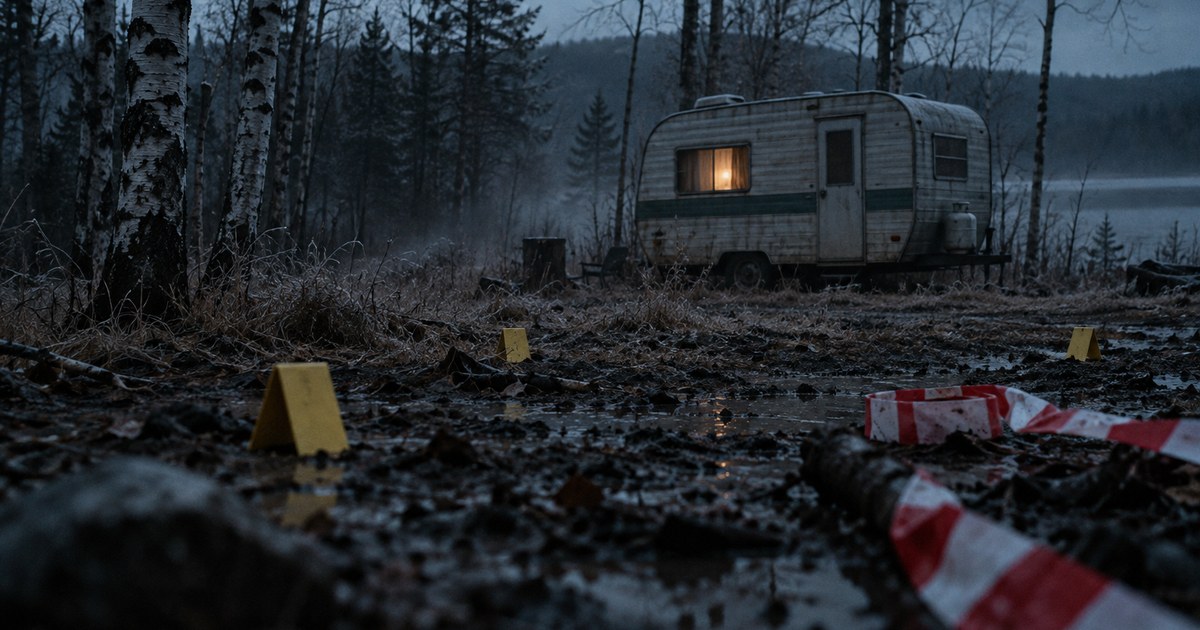
The Report at the Hospital
The case begins at a hospital. On November 22, 2020, Michigan State Police troopers responded to OSF St. Francis Hospital in Escanaba for a report of a sexual assault. What the victim described, according to the Daily Press account published at sentencing, was a period of captivity: she had been held in a camper trailer at Sydney Horvath's residence in Cornell for about eight hours, threatened with a large knife, strangled, and sexually assaulted numerous times by Dustin Aker. Horvath, the account says, participated throughout and threatened the victim herself.
The investigation moved quickly. A search warrant executed at the camper trailer produced handcuffs, bed sheets and clothing that the victim had described. Both defendants were arrested in Schoolcraft County. Aker was found with multiple knives, one of which the victim identified. Within two days the state's forensic machinery was running: a sexual assault examination kit went to the Michigan State Police Forensic Science Division, and a buccal swab was sought from Aker for comparison.
None of that is in dispute, and none of it is the subject of this page. What this page examines is the paper that followed — the plea agreements, the sentencing recommendations, the laboratory reports, and the office's answers when a requester asked for them in April 2026. Those records were not public before. They are now, and they tell a more complicated story than the two-paragraph announcement the office posted when the sentencings were done.
The narrative facts in this section — the eight hours, the knife, the strangling, the handcuffs and sheets, the arrest in Schoolcraft County — come from contemporaneous reporting by the Daily Press, Radio Results Network and My UP News in the first week of March 2022, all of which attributed the underlying information to the Delta County Prosecutor's Office. They are not drawn from a produced court record, because no trial transcript, police report or judgment of sentence was released under these requests. The produced documents establish the charges, the plea terms, the laboratory findings and the sentences. Where this page states a fact that comes from a newspaper rather than a document, it says so.
Case Timeline
The chronology below runs from the report at the hospital to the last of the 2026 records responses. It separates what happened in the criminal case from what happened in the FOIA case, because the two timelines are the point: the events of 2020 and 2021 were resolved long before anyone asked for the file, and the file itself took two batches of requests and two response letters to surface.
Figure 1 · Interactive
The criminal case, from the hospital report to the sentencing
Select any marker to read what happened. Two lanes: the assault and the laboratory investigation, then the pleas and the sentences.
Select a marker on the timeline to read the detail.
Dates in this figure come from the produced documents where a document exists, and from contemporaneous reporting where it does not. The November 22–24 marker combines three consecutive days so that each remains clickable.
Figure 2 · Interactive
The records case, two batches in fifteen days
The same span, drawn to its own scale. Seven requests went out in two batches, and both were answered on the fourth business day.
Select a marker on the timeline to read the detail.
Every date in this figure comes from the office's own response letters and the request stamps on them.
Two Defendants, Two Bargains
The four documents released under FOIA 26-142 are the factual core of this page. They are the Amended Plea Sheet and Plea Sheet for Aker, both dated October 11, 2021; a plea agreement for Horvath dated December 14, 2021; and Horvath's plea sheet dated January 12, 2022. Read together, they show two bargains struck months apart, by two different prosecutors, on very different terms.
Aker: an added count, and everything else dismissed
The Amended Plea Sheet names Hon. John B. Economopoulos as the judge, Lauren Wickman as the prosecuting attorney, and Trenton Stupak as retained defense counsel. It covers two files: 20-10362-FC and 21-10409-FH. The plea, entered October 11, 2021, is no contest to an added Count 5 — criminal sexual conduct, assault with intent to commit sexual penetration — on file 20-10362-FC.
The consideration is sweeping. In exchange for that single plea, the prosecution agreed to dismiss Counts 1, 2, 3 and 4 and the habitual-offender enhancements on 20-10362-FC, and to dismiss file 21-10409-FH in its entirety. It recommended a minimum of “no more and no less than 5 years,” and agreed that Aker could withdraw his plea if the judge did not follow the recommendation. A DNA sample was already on file. The bond on 20-10362-FC was $175,000 cash or surety; on 21-10409-FH it was $75,000. Both are recorded as not posted.
That is a remarkable disposition on its face. A defendant facing a first-degree criminal sexual conduct investigation — the offense code on the laboratory submission is 1100-1, Sexual Assault CSC 1st — pleaded to a single added count carrying a ten-year maximum, and the state dismissed four counts and a whole separate file to get it. The recommendation was five years. The court imposed 80 months, or six years and eight months, to ten years. The office asked for a floor; the court went above it.
Horvath: a non-sexual charge, and a longer maximum
Horvath's plea agreement is a different document with a different prosecutor. It names Andrew Hayse as prosecuting attorney and Diane Kay-Hougaboom as court-appointed defense counsel, on file 20-10354-FH. The plea, entered January 12, 2022, is guilty to Count 1. The prosecution agreed to dismiss Count 2, to seek no sentence enhancement or habitual-offender notice, and not to object to SAI Boot Camp if she were eligible. A DNA sample was ordered that day. Bond was $150,000, ten percent, not posted.
Count 1 was unlawful imprisonment. That is not a sexual offense. Under MCL 750.349b, unlawful imprisonment carries a maximum of fifteen years. Aker's offense, assault with intent to commit sexual penetration under MCL 750.520g, carries a maximum of ten. So the co-defendant who pleaded to a non-sexual charge received a longer maximum — 15 years against 10 — than the man the state's own laboratory tied to the assault by DNA. Her minimum, 71 months, was nine months shorter than his 80, but her ceiling was five years higher.
| Term | Dustin Thomas Aker | Sydney Ann Horvath |
|---|---|---|
| File(s) | 20-10362-FC and 21-10409-FH | 20-10354-FH |
| Plea date | October 11, 2021 | January 12, 2022 |
| Pleaded to | No contest, added Count 5 — assault with intent to commit sexual penetration | Guilty, Count 1 — unlawful imprisonment |
| Statute | MCL 750.520g | MCL 750.349b |
| Statutory maximum | 10 years | 15 years |
| Dismissed | Counts 1–4, habitual enhancements, and all of 21-10409-FH | Count 2 |
| Prosecutor on the sheet | Lauren Wickman | Andrew Hayse |
| Defense counsel | Trenton Stupak, retained | Diane Kay-Hougaboom, court appointed |
| Recommendation | “No more and no less than 5 years” minimum | No stated sentencing recommendation; no objection to Boot Camp |
| Sentence imposed | 80 months (6 yrs 8 mos) to 10 years | 71 months (5 yrs 11 mos) to 15 years |
Two documents, both dated October 11, 2021, record Aker's bond differently. The Amended Plea Sheet says “not posted” on both files; the Plea Sheet says “Posted” on both. Everything else on the two sheets is the same. This is a small thing, but it is the kind of small thing that matters in a records case: the office produced two versions of the same event, and they do not agree.
What the State Lab Found
FOIA 26-141 asked for sixteen categories of forensic reports. The office released four laboratory reports from the Michigan State Police Forensic Science Division, all under Laboratory No. MQ20-1001, submitted by Investigating Officer Steven Wallenius of the MSP Gladstone Post, agency number 84-2521-20, for offense 1100-1, Sexual Assault CSC 1st. The reports are the strongest documentary evidence in the file, and they are unambiguous.
Record 2, issued April 3, 2021, reports the initial analysis of the sexual assault kit by analyst Ann Hunt at the Grand Rapids laboratory. The vulvar fraction 1 was consistent with the victim's own buccal sample. The vulvar fraction 2 and the left-breast swab were mixtures containing at least one male contributor, and both male profiles were entered into CODIS.
Record 3, issued June 30, 2021, compares those profiles against Aker's known buccal sample. The conclusion is stated as a likelihood ratio: the vulvar fraction 2 profile is “approximately 20 octillion times more likely” if it came from the victim and Aker than if it came from the victim and an unrelated person, which the report calls “very strong support that Dustin Aker is a contributor.” The left-breast item is “approximately 500 million times more likely,” also very strong support.
Figure 3 · Laboratory Record 3
Two items, two likelihood ratios
The lab's own figures, as written in the June 30, 2021 report. A likelihood ratio compares the probability of the DNA profile under one hypothesis against another; it is not a probability of guilt.
An octillion is a one followed by twenty-seven zeros. The report describes both results as “very strong support” for Aker as a contributor. The DNA does not by itself establish the circumstances of the assault; that is what the victim's account and the plea establish.
Record 4, issued April 30, 2021, is a Notice of CODIS Association. Analyst John MacDonough reports a moderate-stringency association between the vulvar fraction 2 profile and database specimen MI10-000728, DUSTIN T. AKER, state identification number 2950835M. The notice is stamped “INVESTIGATIVE INFORMATION ONLY,” the standard caveat that a database association is a lead, not a conclusion, until confirmed by a known sample — which Record 3 then did.
Record 5, issued March 21, 2022, is a second Notice of CODIS Association. This one reports a moderate-stringency association between the left-breast item and database specimen MI22-001374, SYDNEY ANN HORVATH, state identification number 4570843K. Its date is worth noting without overreading it: it was issued after Horvath's January 12, 2022 plea and in the same month as her sentencing. The record does not say whether the association was known before the plea, and this page does not assert that it was or was not. It says only what the document says: the left-breast profile was associated with Horvath on March 21, 2022.
They prove that male DNA matching Aker was present on two items, at ratios the lab called very strong support, and that a profile matching Horvath was present on a third. They do not prove the circumstances — the knife, the strangling, the eight hours — and this page does not treat them as if they did. The circumstances come from the victim's account as reported at sentencing and from the plea. The lab reports establish identity and presence. That is enough to make the plea terms worth examining closely, and not enough to make this page a retrial.
The Emails Behind the Plea
FOIA 26-143 asked for sixteen categories of plea-negotiation records. The office released four emails, dated August 12, 2021; October 4, 2021; November 16, 2021; and December 11, 2021. Two of the four are substantially redacted, one of them under a work-product claim. What remains is the most direct look this archive has had at how a plea in this office actually gets built.
“I have Sydney on an A/B charge. Diane has her on a felony. She is looking for a plea deal. Any options? … It looks like her time would be eaten up by her felony count so it should be easy to resolve, I understand there is a video too.”
Attorney Brandon T. Rickard to Brett Gardner, Lauren Wickman and others, August 12, 2021, 11:03 a.m.
The August email is from a Marquette attorney, Brandon T. Rickard, writing to the elected prosecutor, Brett Gardner, and to Wickman, among others. It frames Horvath's exposure as a negotiation problem and volunteers a possible conflict: he and opposing counsel were both appointed in an unrelated probate matter, one as guardian ad litem and one representing the mother. The names in that passage are redacted. The email is a defense-side inquiry, not an office decision, but it shows the plea conversation was already open in August 2021, five months before Horvath entered her plea.
The October 4, 2021 emails are the Aker thread. At 1:25 p.m. Wickman wrote to Gardner and to a second address, subject line “Aker.” At 3:40 p.m. Gardner replied. Both bodies are withheld, in whole or in part, and the office cites work product under MCR 2.302(B)(3)(a), exempt under MCL 15.243(1)(g). Aker's plea was entered seven days later, on October 11. The two emails that most directly precede his plea are the two the public cannot read.
“I know we had contemplated a plea on Horvath but never worked out the details of what an agreement would be. Her plea deadline is 12/17. We need to get something in the works. Please call me about this.”
Diane Kay, defense counsel, to Lauren Wickman, November 16, 2021, 8:41 a.m.
By mid-November the defense was pressing for a deal and the deadline was approaching. Then, on December 11, 2021, Gardner sent Wickman a summary of a phone meeting with Horvath's counsel. The first numbered item is the offer itself:
“Horvath: Offered the Unlawful Imprisonment. Told her D would probably be eligible for Bootcamp, and said the judge would probably consider it. Made no promise to recommend. H said she'd run it by her, and it 'sounded good.'”
Brett Gardner to Lauren Wickman, December 11, 2021, 2:44 p.m.
That single item answers several questions at once. The unlawful-imprisonment offer came from the office, not from the defense. The office described Boot Camp as probably available and said the judge would probably consider it, while expressly making no promise to recommend it. And the offer was communicated by the elected prosecutor to his chief assistant, which tells you who was running the negotiation. Items two through seven of that email are redacted except for fragments — a reference to a “likely plea,” a line about a trial, and a note that the defense had filed an alibi notice with a photograph bearing a 9:30 p.m. timestamp. The email closes with Gardner reporting that defense counsel said her mind “no longer has the 'bandwidth' to discuss anymore cases or to go into further detail.”
There is a structural oddity in the file that the emails make visible. The 2021 negotiations for both defendants ran through Brett Gardner, the elected prosecutor, with Lauren Wickman as his chief assistant. But Aker's plea sheet, dated October 11, 2021, names Wickman as the prosecuting attorney, while Horvath's plea sheet, dated January 12, 2022, names Andrew Hayse. By the time Horvath pleaded, the office's lineup on the paperwork had changed. Nothing in the produced record explains why one defendant's bargain was signed by the chief assistant and the other's by a different assistant, or whether the change in personnel affected the terms. The record simply shows that it happened.
What the Office Released
The seven requests were filed in two batches eight days apart. Both were answered on the fourth business day of the five the statute allows, with no extension, no clarification request, no fee and no deposit. On the procedural measures this archive tracks, that is a clean performance, and it deserves to be said plainly before the criticism starts.
MCL 15.235(2)
Two batches, both answered on day four
The statute gives five business days to grant, deny, or extend. Both response letters used four.
Four of five business days used, in both batches. One day of headroom each time.
The first batch was received Thursday, April 23, 2026 and answered Wednesday, April 29. The second was received Friday, May 1 and answered Thursday, May 7 — again the fourth business day. Business days are counted as weekdays only.
What the two letters produced, however, varied enormously by request. One request was granted in full. Three were granted in part. Two were denied outright. One was answered with a certificate of nonexistence. The scorecard below sets out all seven.
Figure 4 · Interactive
Seven requests, seven answers
Filter by outcome, then select any card to read what the office said and what it produced.
Outcome labels follow the office's own letters. The 26-140 request is listed separately from the two denials because the office's stated ground was that the record does not exist, which is a different answer from a denial based on an exemption.
Page counts tell their own story. Of the roughly forty pages produced across the two batches, more than half came from a single request, and two of the seven produced nothing at all.
The Certificate Problem
A certificate of nonexistence is a powerful document. It tells a requester that the record they asked for does not exist, and under the act it ends the inquiry unless the requester can show otherwise. Because it is powerful, it is also easy to abuse: a public body can certify that a record does not exist without ever saying whether it looked, where it looked, or whether the record might exist somewhere else. This archive has documented that pattern before. The Aker–Horvath file shows it again, and it also shows what a good certificate looks like.
Start with the good one. Request 26-139 asked for sixteen categories of autopsy and death-investigation records. The office denied it in full and wrote a single sentence that resolves the request completely: “No one died that resulted in this investigation, as such no autopsy was conducted.” That is what a certificate should do. It tells the requester that the premise of the request was wrong, and why. A reader who receives that sentence knows there is nothing to appeal, because there is nothing to find.
Now compare request 26-140. It asked for sixteen categories of fingerprint records: fingerprint cards for Aker and Horvath, identification reports, AFIS results, comparison reports, chain-of-custody records, latent-print reports, match-probability analyses, classification records, quality assessments, exclusion reports, method documentation, and more. The office denied it as a record that does not exist and issued a certificate of nonexistence. It did not say that no prints were lifted, that no comparison was requested, or that any such records would be held by the Michigan State Police. It said only that the record does not exist.
Figure 6
Two certificates, two levels of explanation
Both requests were denied in full. Only one denial tells the requester why the record is absent.
The bars are a qualitative comparison, not a measurement: two for a denial that explains itself, zero for one that does not. The underlying documents are quoted in full below.
It is possible that the fingerprint records genuinely do not exist in the prosecutor's office. Fingerprint analysis is typically a police and state-lab function, and the office may never have held the cards or the AFIS reports. But that is exactly the point: if the records are held elsewhere, the certificate should say so, the way the 26-136 letter did when it told the requester that further affidavits “may be in the possession of the Michigan State Police.” The 26-140 certificate says nothing of the kind. It asserts absence and stops.
The May 7, 2026 letter answers four requests. For 26-140 it certifies nonexistence with no explanation. For 26-141 it produces four laboratory reports. For 26-142 it produces four plea documents. For 26-143 it produces four emails and withholds part of one under a named exemption. Three of the four answers show the office can identify a record, describe it, and either produce it or name the legal basis for withholding it. The fourth shows the office can also decline to explain. The difference is not capacity. It is choice.
Analysis: A Sentence Above the Recommendation
The most consequential fact in this file is a number. Aker's plea agreement recommended a minimum of “no more and no less than 5 years.” He was sentenced to a minimum of 80 months — six years and eight months, or twenty months above the recommendation. That is not a scandal. A judge is free to exceed a recommendation, and the plea sheet expressly allowed Aker to withdraw his plea if the judge did not follow it, which means the possibility was contemplated. But it is a fact that the office's public announcement did not mention, and it changes how the bargain reads.
Consider what the office gave up to get the plea. It dismissed four counts on 20-10362-FC, dismissed the habitual-offender enhancements, and dismissed file 21-10409-FH entirely. In return it got a no-contest plea to a single added count with a ten-year maximum, and it recommended five years. When the court imposed more than the office asked for, the office's recommendation became a floor that the sentence exceeded. A member of the public reading only the sentencing announcement would not know that the prosecutor had asked for less than what was imposed, or that four counts and a second file had been dropped to secure the plea.
Then there is the asymmetry between the two defendants. Horvath pleaded guilty to unlawful imprisonment, a non-sexual offense, and received a maximum of fifteen years. Aker pleaded no contest to assault with intent to commit sexual penetration, a sexual offense, and received a maximum of ten years. The person the state's own laboratory identified as a contributor to the DNA on two items received the shorter ceiling. The person who was not identified as a contributor to those items received the longer one.
There may be entirely legitimate reasons for that. Horvath's conduct, as described at sentencing, included holding and threatening the victim, and unlawful imprisonment is a serious charge with a substantial maximum. Sentencing is individualized, and a judge weighs factors this page cannot see. But the office's public announcement described both sentences in a single paragraph without explaining why the co-defendant's ceiling exceeded the principal offender's. A reader would have to obtain the plea sheets — which required a FOIA request — to learn that the two defendants pleaded to different kinds of offenses, before different prosecutors, months apart.
That is the transparency point, and it is narrow. This page does not argue that either sentence was wrong. It argues that the office possessed, in its own plea files, the facts that would let the public understand the two sentences together, and that its announcement did not provide them. The records were available. They were produced, eventually, at no charge. But they were not volunteered, and the announcement read as though the two outcomes were symmetrical when the documents show they were not.
Transparency Concerns and Open Questions
Set out plainly, the concerns this file supports are these.
At sentencing, an announcement that stated the recommendation and the sentence together, so the public could see the gap. In the 26-140 response, a sentence explaining whether fingerprint records were ever created in this investigation and, if they were held elsewhere, where. In the 26-142 response, a note that the subject line did not match the enumerated items. And, if the office's position is that the two October 4 emails are privileged work product, a description specific enough to let a requester test the claim — which MCL 15.235(5) contemplates and which a blanket citation does not supply.
Comparison With Other Requests
This file is unusual in the archive for one reason: it is the first case watch built from requests that were answered quickly, completely and free. Most of the FOIA record on this site is a record of delay, fee walls and certificates of nonexistence. The Aker–Horvath requests did none of that. They were answered on day four, twice, at no charge, with real documents attached. That makes the few failures stand out more, not less.
| Factor | Aker–Horvath 26-136 to 26-143 |
#26-131 Felony sex-offense files |
#25-130 UPSET bar raid |
|---|---|---|---|
| Requests | Seven, in two batches | One | One |
| Response time | 4 business days, both batches | 4 business days | 4 business days |
| Fee quoted | $0 | $82.66 | $0 |
| Deposit required | None | $41.33 | None |
| Records produced | 40 pages | 0 pages | 2 judgments |
| Certificates of nonexistence | 3 (26-137, 26-139, 26-140) | 0 | 0 |
| Exemption cited | MCL 15.243(1)(a); MCL 15.243(1)(g); MCL 28.214(5) | MCL 15.243(1)(a) | None — subsection blank |
| Core problem | Two unexplained certificates and a withheld plea thread | A fee wall before a single page | A co-defendant omitted entirely |
The comparison is instructive. In 26-131 the office quoted $82.66 and produced nothing, and four-fifths of the fee was the cost of reviewing its own files. In the Aker–Horvath requests the office produced forty pages at no charge, including four laboratory reports and four plea documents, and asked for nothing. The difference cannot be explained by volume or difficulty. It can only be explained by the office's decision in each case about whether to charge. That decision is discretionary, and this file shows the office exercising it in the requester's favor — which makes the fee wall in 26-131 harder to defend, not easier.
The certificates are the other side of the same coin. The office can explain a denial when it chooses to, as 26-139 shows. When it does not choose to, as 26-140 shows, the requester is left with an assertion and no way to test it. Both certificates were issued in the same letter, on the same day, by the same coordinator. The difference between them is not capacity. It is whether someone decided the requester deserved an explanation.
FOIA Request Details
What was requested
Each request was enumerated as sixteen numbered items. 26-136 asked for affidavits of every kind in the case. 26-137 asked for arrest warrants. 26-139 asked for autopsy findings. 26-140 asked for fingerprint records. 26-141 asked for forensic reports. 26-142, under the subject line “Finger Prints,” actually enumerated sixteen plea-agreement items. 26-143 asked for plea-negotiation records. Every request asked for production in full with non-exempt portions segregated, electronic delivery, advance notice of fees, and a public-interest fee waiver under MCL 15.234.
What was provided
Two response letters, dated April 29 and May 7, 2026, both signed by Emily DeSalvo as FOIA Coordinator on the letterhead of Lauren M. Wickman. Forty pages of records: sixteen pages of search-warrant packets, fourteen pages of laboratory reports, five pages of plea documents, and five pages of emails. Three certificates of nonexistence, two for records the office says it does not hold and one for records it says do not exist. No fee, no deposit, and no fee-waiver decision, because there was no fee to waive.
The documents themselves
Every produced page is reproduced below as a redacted copy. The requester's name, address, telephone number, e-mail address and fax identifiers have been removed from the response letters and the request stamps; the defendants' dates of birth and state identification numbers were redacted by the office. Nothing substantive has been altered, and the unredacted originals are retained privately.
What was withheld
Personal identifiers, LEIN information and victim images under MCL 15.243(1)(a) and MCL 28.214(5). Part of the October 4, 2021 Aker email thread, as work product under MCR 2.302(B)(3)(a) and MCL 15.243(1)(g). All arrest warrants, which the office says it does not possess. All fingerprint records, which the office certifies do not exist. All autopsy records, which the office says were never created because no one died. Any further affidavits beyond the three packets released, which the office says are held, if at all, by the Michigan State Police.
Remedies, Deadlines and Next Steps
The determinations in this file are recent. The first response is dated April 29, 2026 and the second May 7, 2026. Under MCL 15.240(1), a person denied all or part of a request may appeal in writing to the head of the public body or sue in circuit court, and the limit is 180 days from the final determination. For the May 7 determination, that window runs into early November 2026. It has not closed.
What a narrower request could still obtain
The productive move is to name the record rather than the category. For the fingerprint question, ask whether any fingerprint or latent-print examination was requested in this investigation, and if so, which agency performed it and where the resulting records are held. That framing defeats a bare certificate, because it asks for a record of a request rather than for the prints themselves. For the arrest warrants, ask the Michigan State Police directly, since the office says it does not hold them. For the withheld October 4 emails, ask for a log of the emails in the Aker thread — senders, recipients, dates and subject lines — which may be segregable even if the bodies are not.
If a fee is quoted on a new request
These seven requests cost nothing, but the office has quoted four-figure fees elsewhere in this archive. If a fee is quoted, MCL 15.234(2) requires an itemization stating both the hourly wage and the number of hours. A body not in compliance with the act's procedures may not charge fees at all under MCL 15.234(4). Fee disputes have their own path under MCL 15.240a, including a civil action within 45 days.
If a denial is appealed or litigated
In circuit court the burden is on the public body to sustain the denial, and review is de novo. Where the court finds that the body arbitrarily and capriciously violated the act, MCL 15.240(7) provides a civil fine of $1,000 and punitive damages of $1,000, in addition to attorney fees and costs.
What this site will do
This page will be updated if the office produces a record explaining the fingerprint certificate, releases any part of the October 4 email thread, or reconciles the two Aker plea sheets. Corrections of fact are published as corrections, not as silent edits. Anyone with a document that bears on the points above is invited to send it.
Sources and Method
This page was built from five document sets produced under seven FOIA requests: the April 29, 2026 response letter with its three search-warrant packets and three certificates of nonexistence; the May 7, 2026 response letter with its denial forms; four laboratory reports from the Michigan State Police Forensic Science Division; four plea documents; and four emails. Every quotation attributed to the office or to counsel is transcribed from those pages. The redacted PDFs linked on this page are faithful copies with requester identifiers removed; the unredacted originals are retained privately and are available to the county, to counsel, or to a court on request.
Three contemporaneous news accounts establish the narrative facts that the produced records do not contain — the eight hours, the knife, the strangling, the handcuffs and sheets, the arrest in Schoolcraft County, and the two sentences. They are the Daily Press report of March 8, 2022, “Pair get prison terms for sexual assault, holding victim captive”; Radio Results Network's report of March 7, 2022; and My UP News's report by Tor Thorne of March 7, 2022, which attributes the announcement to the Delta County Prosecutor's Office's own Facebook post. Where a fact comes from one of those accounts rather than from a produced document, the text says so. Newspaper reporting is treated as evidence of what was publicly stated, not as a substitute for a court record.
Statutory text is quoted from the Michigan Compiled Laws as published by the Michigan Legislature. The provisions relied on are MCL 15.232 (definitions), MCL 15.235 (response and denial requirements), MCL 15.240 (appeals and remedies), MCL 15.240a (fee appeals), MCL 15.243 (exemptions, including the privacy and work-product exemptions), MCL 15.244 (segregation), MCL 28.214 (LEIN confidentiality), MCL 750.349b (unlawful imprisonment), MCL 750.520b (first-degree criminal sexual conduct) and MCL 750.520g (assault with intent to commit sexual penetration). MCR 2.302(B)(3)(a) is cited because the office cited it.
Three categories of statement are kept separate throughout. Documented facts are things that appear on the face of a produced record — case numbers, plea terms, laboratory findings, dates, sentences and the text of the denials. Publicly reported facts are things stated in contemporaneous news coverage, chiefly the circumstances of the assault and the two sentences, and are labelled as such. Interpretation is this site's reading of the statutes and of the response, and is labelled as such. Where the record is silent — on why the two plea sheets disagree about bond, on whether the fingerprint records exist elsewhere, on why the two October 4 emails are privileged — this page says it is silent rather than supplying an inference.
This is not an investigation into whether Dustin Aker or Sydney Horvath committed the offenses to which they pleaded. They did plead, they were sentenced, and the DNA evidence is strong. This is an investigation into what a prosecutor's office did with its own records of that case: what it recommended, what it agreed to, what it announced, and what it produced when asked. Those are different questions, and the answers to them are in the documents.