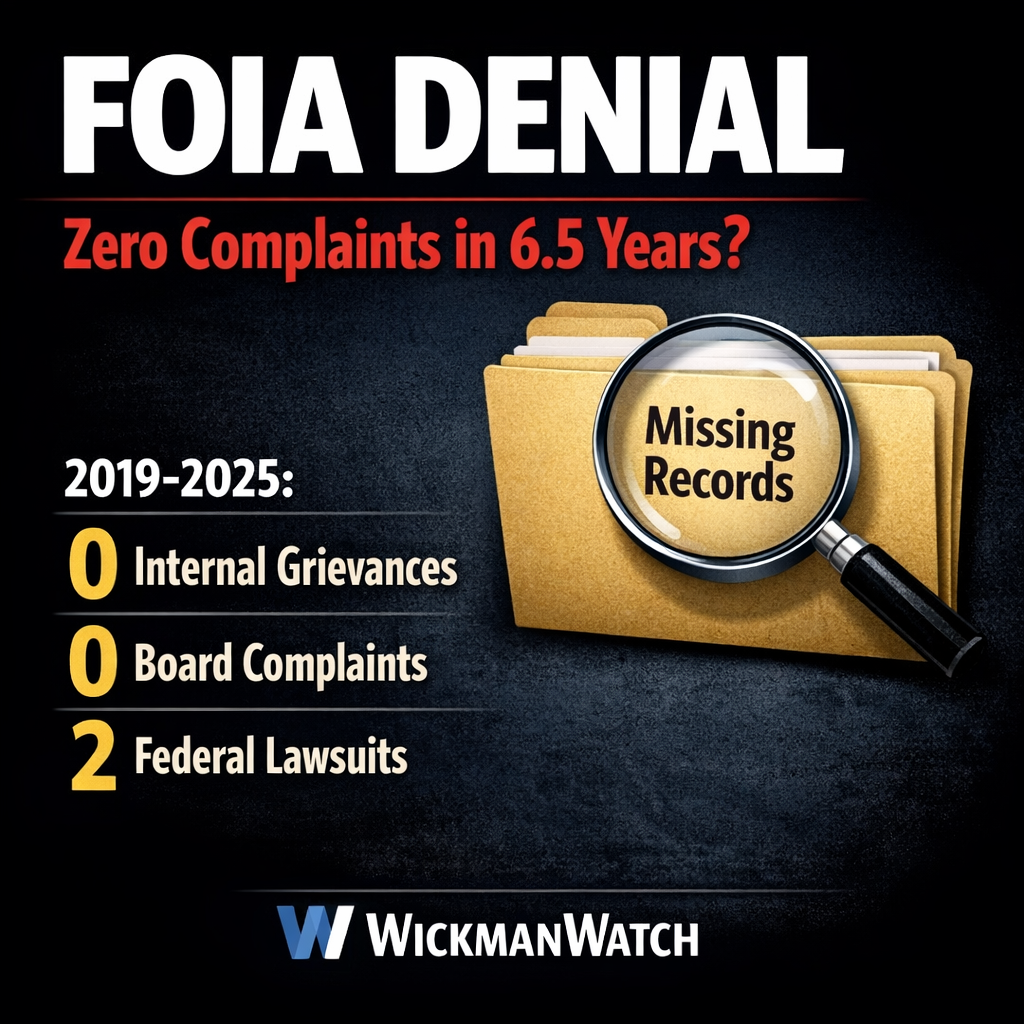
FOIA Request #25-197: Complaints Against Prosecutor’s Office – Partial Disclosure, Troubling Denials
Date: August 13, 2025 (Request) → September 3, 2025 (Response)
Requestor: Joseph Parrotta
Status: Granted in Part, Denied in Part
Timeframe Requested: January 1, 2019 through date of processing
The Request
On August 13, 2025, We submitted a comprehensive FOIA request seeking:
“All complaints, grievances, or formal allegations filed against the Delta County Prosecutor’s Office or its employees from January 1, 2019, through the date this request is processed.”
The request specifically included:
- Written complaints from the public, law enforcement, court staff, or other government agencies
- Internal grievances filed by Prosecutor’s Office employees
- Complaints submitted to oversight bodies, professional licensing boards, the State Bar of Michigan, or the County Board of Commissioners
- Records of resolution, investigation, or disposition of such complaints
- Both draft and final versions
- All records regardless of labeling (confidential, personnel, internal, administrative use only)
This was a legitimate request for oversight and accountability records – exactly the type of information the public should have access to regarding a public prosecutor’s office.
What Was Provided
The Prosecutor’s Office GRANTED portions of the request and provided the following documents:
Kurtis Kobasic v. Delta County and Lauren Wickman
- First Amended Complaint (federal civil rights lawsuit)
- Motion for Summary Judgment
- Release and Settlement Agreement
John Roberts v. Jon Doe Delta County Prosecutor, et al.
- Complaint (federal civil rights lawsuit)
- First Amended Complaint
- Prosecutor’s Office Response in Opposition to Motion to File First Amended Complaint
- United States District Court Opinion Regarding Motions to Dismiss
- Order and Judgment to Dismiss Case
Analysis: These are public federal court records already available on PACER (Public Access to Court Electronic Records). Providing court documents that are already public records is not a meaningful fulfillment of the FOIA request – these documents should have been accessible without a FOIA request.
What Was Denied
1. Internal Grievances – DENIED (Records Don’t Exist)
“Your request for records of ‘[i]nternal grievances filed by Prosecutor’s Office employees’ is DENIED as a review of the records reveal they do not exist.”
The Claim: The Prosecutor’s Office certifies that after a search, no internal grievance records exist.
The Problem: This is highly improbable. From January 1, 2019 through August 2025 (over 6.5 years), it is virtually impossible that a prosecutor’s office with multiple employees had ZERO internal grievances filed. This raises questions about:
- Whether a proper search was actually conducted
- Whether grievances were processed informally without documentation
- Whether grievance records exist under different names or classifications
- Whether employees were discouraged from filing formal grievances
Key Question: If no internal grievances exist in over 6.5 years, what does that say about the workplace culture? Does it indicate fear of retaliation, lack of proper grievance processes, or simply that employees don’t bother because they know nothing will change?
2. Complaints to Oversight Bodies – DENIED (Privileged)
“Your request for records of ‘[c]omplaints submitted to oversight bodies, professional licensing boards, the State Bar of Michigan…’ is DENIED as pursuant to MCR 9.126 any such investigations not resulting in formal charges are privileged from disclosure, confidential, and may not be made public. As such, any such records are exempt pursuant to MCL 15.243(1)(h).”
The Claim: Investigations by the State Bar of Michigan or other oversight bodies that don’t result in formal charges are privileged and confidential.
The Legal Issue: MCR 9.126 does provide confidentiality for certain attorney grievance proceedings, but this exemption:
- May not apply to investigations that were closed or never initiated
- Does not necessarily apply to complaints submitted by members of the public
- May not apply to complaints that were referred to other agencies
- The existence of complaints (as opposed to the content of investigations) may still be disclosable
The Problem: The Prosecutor’s Office is taking an overly broad interpretation of the privilege. At minimum, they should be able to provide:
- A log of how many complaints were filed
- Dates of complaints
- Agencies to which complaints were submitted
- Dispositions (without detailed findings)
Complete denial without even providing aggregate information suggests either over-protectiveness or a desire to hide the existence of complaints.
3. Complaints to County Board of Commissioners – DENIED (Records Don’t Exist)
“Your request for records of ‘[c]omplaints submitted to … or the County Board of Commissioners’ is DENIED as a review of the records reveal they do not exist.”
The Claim: No complaints about the Prosecutor’s Office were ever submitted to the County Board of Commissioners.
The Problem: Similar to the internal grievance denial, this is improbable. Over 6.5 years, it’s highly unlikely that no citizen ever complained to the County Board about the Prosecutor’s Office. This raises questions about:
- Whether the County Board has a system for receiving and documenting such complaints
- Whether complaints were directed elsewhere (back to the Prosecutor’s Office itself)
- Whether a proper search was conducted of Board records
Conclusion
Key Issues and Concerns
1. Improbable “No Records” Certifications
The Prosecutor’s Office certified that NO internal grievances exist and NO complaints were submitted to the County Board over 6.5 years. This is statistically improbable and suggests either:
- Incomplete or inadequate searches
- Failure to maintain proper records
- A workplace culture that discourages formal complaints
- Informal handling of complaints without documentation
2. Overly Broad Application of Privilege
The denial of oversight body complaints relies on MCR 9.126, but this privilege:
- May not apply to all types of oversight investigations
- Should not preclude disclosure of basic information (dates, agencies, dispositions)
- Is being interpreted in the most restrictive possible manner
3. Providing Already-Public Records
The response provided federal court records that are already publicly available on PACER. This is not meaningful compliance with FOIA – it’s providing information the requestor could have obtained without filing a FOIA request. The public records requested should have included internal complaints, not external court filings.
4. Pattern of Obstruction
This response is consistent with a broader pattern of FOIA obstruction by the Delta County Prosecutor’s Office, including:
- Repeated use of technical exemptions to deny legitimate requests
- Incomplete searches resulting in “records don’t exist” certifications
- Excessive fee estimates to deter requests
- Selective disclosure of easily accessible documents
What the Provided Lawsuits Reveal
Kurtis Kobasic v. Delta County and Lauren Wickman (2020)
Allegations: Constitutional violations, unlawful seizure of property (a dog), procedural due process violations
Key Claims:
- Lauren Wickman filed a dangerous dog case without properly investigating ownership
- Wickman attested to facts not within her personal knowledge
- A co-owner of the dog was not served as required by law
- The dog was ordered to be destroyed without all owners being given due process
Outcome: Settled (the release and settlement agreement is provided, but terms are not visible)
Significance: This shows that citizens have felt compelled to file federal civil rights lawsuits against Lauren Wickman for alleged constitutional violations and improper prosecutorial practices.
John Roberts v. Delta County Prosecutor, et al. (2019)
Allegations: First, Fourth, and Fourteenth Amendment violations, medical marijuana rights
Key Claims:
- Plaintiff used medical marijuana for brain aneurysm/stroke treatment
- Defendant actions prevented plaintiff from accessing medication
- Plaintiff suffered a full occlusion of left brain artery as a result
- Detention, property confiscation, and restrictive bond conditions
Outcome: Case dismissed by United States District Court
Significance: Another federal civil rights lawsuit alleging prosecutorial misconduct and constitutional violations, this time related to medical marijuana and due process.
Conclusion
FOIA Request #25-197 reveals a deeply troubling pattern:
- Statistically improbable denials: Claiming zero internal grievances and zero Board complaints over 6.5 years strains credibility.
- Overly broad privilege claims: Using MCR 9.126 to deny even basic information about oversight complaints.
- Providing already-public documents: Offering federal court records that are available without FOIA instead of meaningful internal records.
- Evidence of actual lawsuits: The presence of federal civil rights lawsuits demonstrates that citizens HAVE filed serious allegations against the Prosecutor’s Office, yet the FOIA response claims no formal complaints exist in other channels.
The public has a right to know about complaints against their elected prosecutor. The Delta County Prosecutor’s Office’s response to this FOIA request suggests a lack of transparency and accountability that should concern every resident of Delta County.
Request Status: Granted in Part, Denied in Part
Next Steps: File targeted FOIA requests to County agencies, State Bar, and Attorney General to obtain complaint records that the Prosecutor’s Office claims don’t exist or can’t disclose.
References and Documents Analyzed – Click any of the links below for the Reponsive Document
- FOIA Request #25-197 (August 13, 2025)
- FOIA Response #25-197 (September 3, 2025)
- Kurtis Kobasic v. Delta County and Lauren Wickman – First Amended Complaint
- Kurtis Kobasic v. Delta County and Lauren Wickman – Release and Settlement Agreement
- John Roberts v. Delta County Prosecutor, et al. – First Amended Complaint
- John Roberts v. Delta County Prosecutor, et al. – Order and Judgment Dismissing Case
- Michigan Court Rules: MCR 9.126 (Attorney Grievance Commission confidentiality)
- Michigan Freedom of Information Act: MCL 15.243(1)(h) (Investigating records exemption)

Leave a comment