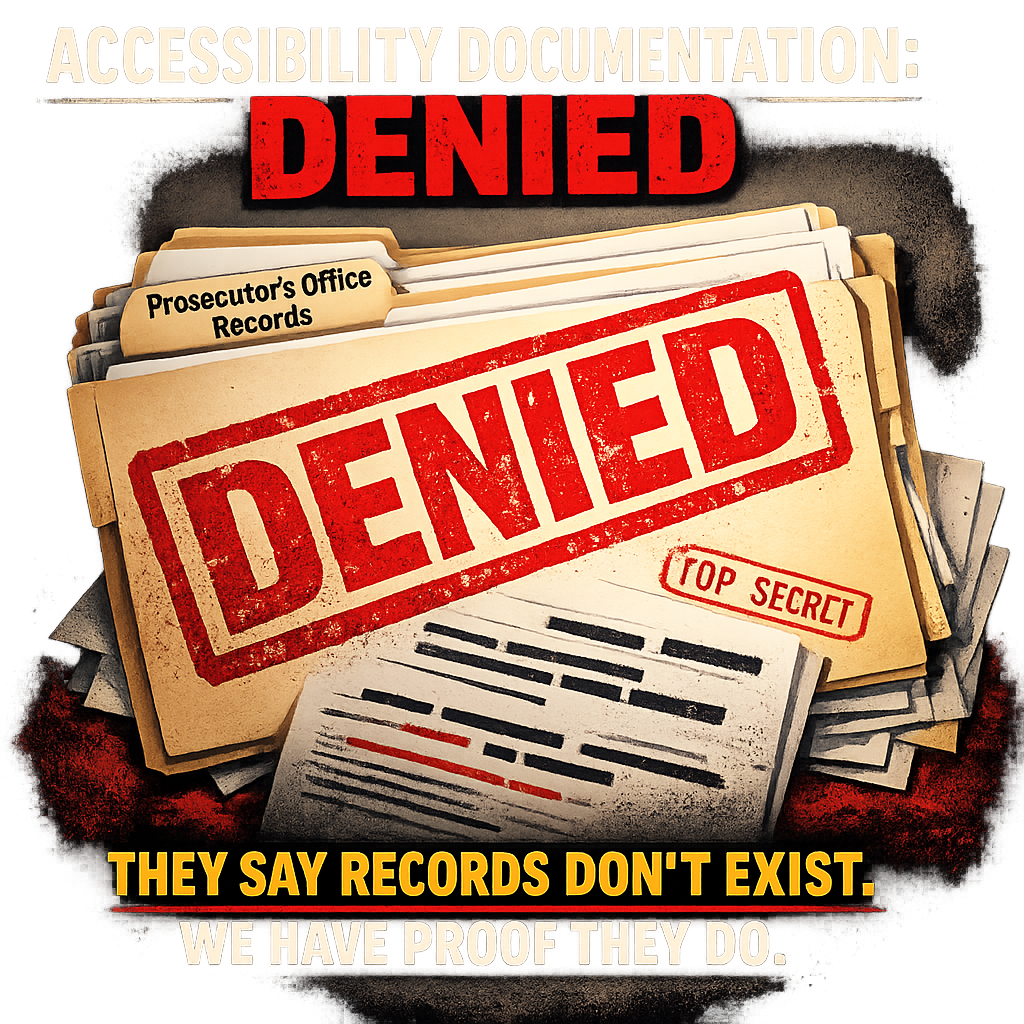
FOIA Request #26-64: “Records Don’t Exist” — But They Must
Filed: March 3, 2026
Response: March 11, 2026
Status: DENIED — Records Do Not Exist
What Was Requested
I requested any records acknowledging that certain records are temporarily inaccessible due to the system migration from the legacy Adult/Juvenile Case Tracking (ACT/JCT) system to ProsecutorbyKarpel.
This was a straightforward request designed to answer a simple question: If data was excluded from migration, is there any documentation acknowledging that it’s temporarily inaccessible?
What Was Provided
NOTHING.
The Prosecutor’s Office denied the request, stating:
“Your request is DENIED as a review of records maintained or possessed by the public body reveals they do not exist. The undersigned hereby certifies that, after a search for records and to the best of the undersigned’s knowledge and belief, the public record requested, and described above, does not exist within the records of the public body…”
Why This Denial Is Implausible
This denial is not just improper — it’s implausible. Here’s why:
1. We Already Know Data Was Excluded
The February 6, 2024 email obtained through FOIA Request #26-44 explicitly states:
“They don’t want everything in Karpel as we don’t want to pay for additional storage at this time.”
This email confirms that:
- Deliberate decisions were made about what data to exclude
- The exclusion was driven by cost (saving on storage fees)
- Someone in the Prosecutor’s Office made these decisions
The question is not whether data was excluded — we know it was. The question is whether there’s any documentation acknowledging this.
2. Professional IT Practices Require Documentation
No IT professional transitions from one case management system to another without creating documentation. Standard practice includes:
- Migration completion reports — Documenting what was successfully transferred
- Exception reports — Identifying what data could not be migrated
- Data gap analysis — Analyzing which records are inaccessible in the new system
- Legacy access procedures — Documenting how to access data that remains in the old system
- Status memos — Confirming whether migration is complete or ongoing
It is professionally negligent to transition a criminal justice system without documenting data gaps and access procedures.
3. The Legacy System Still Contains Data
If historical data was not migrated to ProsecutorbyKarpel, that data must still exist somewhere — either:
- In the legacy ACT/JCT system
- In backup archives
- In cold storage
- In some other format
If the legacy system still contains data that prosecutors, attorneys, or judges might need to access, there MUST be documentation about:
- How to access that legacy data
- Which records are in which system
- Whether the legacy system is still maintained
- Who has access to legacy records
4. The Prosecutor’s Office Cannot Operate Without This Information
Consider the practical implications:
- A defense attorney requests a plea agreement from 2022
- A victim needs to verify a case disposition from 2021
- A judge orders a review of historical sentencing patterns
- An appeal requires access to pre-2024 case files
If these records exist only in the legacy system, the Prosecutor’s Office needs documentation about:
- Which records are in which system
- How to access legacy data when needed
- Who is responsible for maintaining legacy access
- Whether legacy access is “temporary” or permanent
Without such documentation, the office could not function effectively or respond to legitimate requests for historical case information.
5. The February 6, 2024 Email Itself Is a Record
The February 6, 2024 email from #26-44 — which acknowledges that data was excluded to save on storage fees — IS itself a record acknowledging that certain records may be inaccessible.
This email should have been provided as responsive to Request #26-64. Instead, the Prosecutor’s Office claimed “no records exist.”
What Should Exist
A complete and professional system migration would have generated all of the following:
Migration Documentation
- Migration completion report — Formal document stating whether migration is complete
- Data gap analysis — Report identifying which data categories were not migrated
- Exception report — List of specific records that could not be transferred
- Quality assurance documentation — Records showing verification of migrated data
Access Documentation
- Legacy system access procedures — Instructions for accessing data that remains in ACT/JCT
- Data location matrix — Document showing which records are in which system
- Access authorization list — Who has permission to access legacy data
- System status memo — Whether ACT/JCT is still active, archived, or decommissioned
Decision Documentation
- Exclusion decision records — Memos or emails documenting what data was excluded and why
- Cost-benefit analysis — Documents showing how much storage fees were saved vs. the cost of excluded data
- Stakeholder notifications — Records showing whether attorneys, judges, or others were notified about data gaps
The February 6, 2024 Email — Already Obtained
- Email chain from FOIA #26-44 — Contains the admission: “They don’t want everything in Karpel as we don’t want to pay for additional storage at this time.”
This email alone should have been provided as responsive to Request #26-64, as it explicitly acknowledges that records were excluded from migration.
Why This Matters
This denial is not just bureaucratic obstruction — it’s a denial of the public’s right to know about potential gaps in the justice system’s record-keeping.
Justice System Integrity
If historical records are inaccessible or lost, that affects:
- Defendants’ rights — The right to access evidence and case history
- Victims’ rights — The right to know case outcomes
- Attorneys’ ability to represent clients — Need for complete case histories
- Judicial oversight — Courts need access to complete records for appeals and sentencing
Transparency
Taxpayers have invested over $109,000 in ProsecutorbyKarpel. They deserve to know:
- Is the system complete?
- Were historical records preserved?
- Can the public access pre-2024 case information?
- How are requests for historical data handled?
Accountability
If the Prosecutor’s Office made decisions to exclude data to save on storage costs, they should be accountable for those decisions. The public deserves to know:
- What was excluded?
- Why was it excluded?
- Who made the decision?
- What are the consequences?
The Pattern of Denial
This denial fits an increasingly clear pattern:
| FOIA Request | Critical Question | Response | Status |
|---|---|---|---|
| #26-44 | Is migration complete? | 156 pages (no direct answer) | Incomplete |
| #26-45 | Migration timelines? | NOTHING | DENIED |
| #26-56 | What data was excluded? | NOTHING | DENIED |
| #26-57 | Full financial costs? | NOTHING | DENIED |
| #26-63 | Funding promise? | Email showing promise | Granted |
| #26-64 | Records inaccessible? | “Don’t exist” | DENIED |
The Prosecutor’s Office is systematically blocking access to any documentation that would reveal:
- The full scope of data exclusion
- The timeline of migration decisions
- The complete financial picture
- Acknowledgments of any gaps or problems
The Absurdity of the Denial
Consider what the Prosecutor’s Office is asking us to believe:
- They transitioned from a legacy system to a new one
- They deliberately excluded data to save on storage fees (as confirmed in the Feb 6 email)
- They created NO documentation of what was excluded
- They created NO procedures for accessing excluded data
- They created NO memos acknowledging any gaps in the new system
- They have NO way to tell staff how to access historical records
- The February 6, 2024 email — which explicitly discusses data exclusion — somehow doesn’t count as a “record acknowledging that certain records are temporarily inaccessible”
This defies logic, professional standards, and common sense.
No IT department operates this way. No justice system can function this way. No public agency can claim to be transparent while hiding this much information.
What Should Happen
For the Prosecutor’s Office
- Conduct a thorough search — Look for migration documentation in IT files, project folders, Karpel correspondence, and staff emails
- Review all Karpel-related communications — Look for acknowledgments of data gaps or access issues
- Check with IT Director Brandon Couvillion — He would have created or received migration documentation
- Check with project lead Paige Tardiff — She oversaw the rollout and would know about any access issues
- Provide the February 6, 2024 email — At minimum, this document is responsive to the request
For the Public
- File an appeal — This denial should be appealed to the Delta County Board of Commissioners
- Request sworn testimony — Under oath, IT staff should be asked whether migration documentation exists
- Demand accountability — The public deserves to know whether justice system records are complete and accessible
The Bottom Line
The Prosecutor’s Office claims no records exist acknowledging that certain records are temporarily inaccessible due to the system migration.
But we already have an email saying data was excluded to save on storage fees.
And we know that no professional IT transition happens without documentation.
The denial is implausible, the claim is absurd, and the pattern is clear: the Prosecutor’s Office is hiding information about what was lost, left behind, or made inaccessible when they spent over $100,000 on a new case management system.
The public deserves answers — not implausible denials.
Note: This denial is currently being evaluated for appeal. The February 6, 2024 email from FOIA Request #26-44 alone should have been provided as responsive to this request, as it explicitly acknowledges that data was excluded from migration.
We will update this page as the appeal process unfolds.

Leave a comment