FOIA #26-46 & #26-44: Behind the Scenes of ProsecutorbyKarpel Implementation
March 2026 – In our ongoing examination of Delta County’s implementation of the ProsecutorbyKarpel case management system, two previously obtained FOIA responses provide valuable insight into both the costs and the day-to-day operations of bringing this system online.
While these responses don’t include the original request letters or response explanations, the documents themselves – a detailed invoice and 156 pages of operational emails – reveal important information about how the system was implemented and what it costs to operate.
What Was Provided
FOIA #26-46: The Year 4 Invoice
This response contains a single invoice from Karpel Solutions dated January 27, 2026, with a total of $11,075.00. What makes this invoice significant is what it represents: evidence of the transition from state-coordinated billing to direct county billing.
Invoice Details:
- Invoice Number: 76350
- Billing Period: “Delta Year 4 Annual Billing: June 2027- May 2028”
- Billed To: Delta County Prosecutor’s Office (not PAAM)
- Attention: Dianna Collins
- Payment Terms: Net 30 days, due February 26, 2026
Cost Breakdown: The invoice provides a detailed breakdown of annual operating costs:
| Item | Quantity | Unit Price | Annual Cost |
|---|---|---|---|
| Annual PBK Maintenance | 9 | $450.00 | $4,050.00 |
| PBK External Agency & eSubpoena | 1 | $1,000.00 | $1,000.00 |
| Annual PBK Hosting Fee | 9 | $100.00 | $900.00 |
| PBK E-Discovery Annual Service Fee | 9 | $125.00 | $1,125.00 |
| PBK Annual Interface Maintenance: LEIN | 1 | $1,000.00 | $1,000.00 |
| PBK Annual Interface Maintenance: VINE | 1 | $1,000.00 | $1,000.00 |
| PBK Annual Interface Maintenance: MSP Lab | 1 | $2,000.00 | $2,000.00 |
| Total | $11,075.00 |
FOIA #26-44: 156 Pages of Implementation Communications
This response contains a comprehensive collection of email communications between Delta County staff and Karpel Solutions personnel, spanning from October 2023 through May 2024. These documents provide a behind-the-scenes look at how the ProsecutorbyKarpel system was actually implemented.
Key Correspondents:
- Brandon Couvillion: Director of Information Technology, Delta County
- Jordan Felix: PbK Technical Operations Coordinator, Karpel Solutions
- Blake Randolph: PbK Project Implementation Specialist, Karpel Solutions
- Pippa Barrett: Client Solutions Lead, Karpel Solutions
- Lauren Wickman: Delta County Prosecutor’s Office
What the Documents Reveal
1. The Billing Transition is Real
The most significant finding from FOIA #26-46 is concrete evidence that Delta County is now being billed directly for ProsecutorbyKarpel costs. As we discussed in our analysis of FOIA #25-201, the contract between the Prosecuting Attorneys Association of Michigan (PAAM) and Delta County specified that PAAM would serve as the “central billing entity” until September 30, 2026, after which each county would be billed individually.
This January 2026 invoice, covering Year 4 (June 2027-May 2028), is addressed directly to Delta County Prosecutor’s Office, not to PAAM. This provides clear documentation that the transition from state-coordinated billing to direct county billing has occurred.
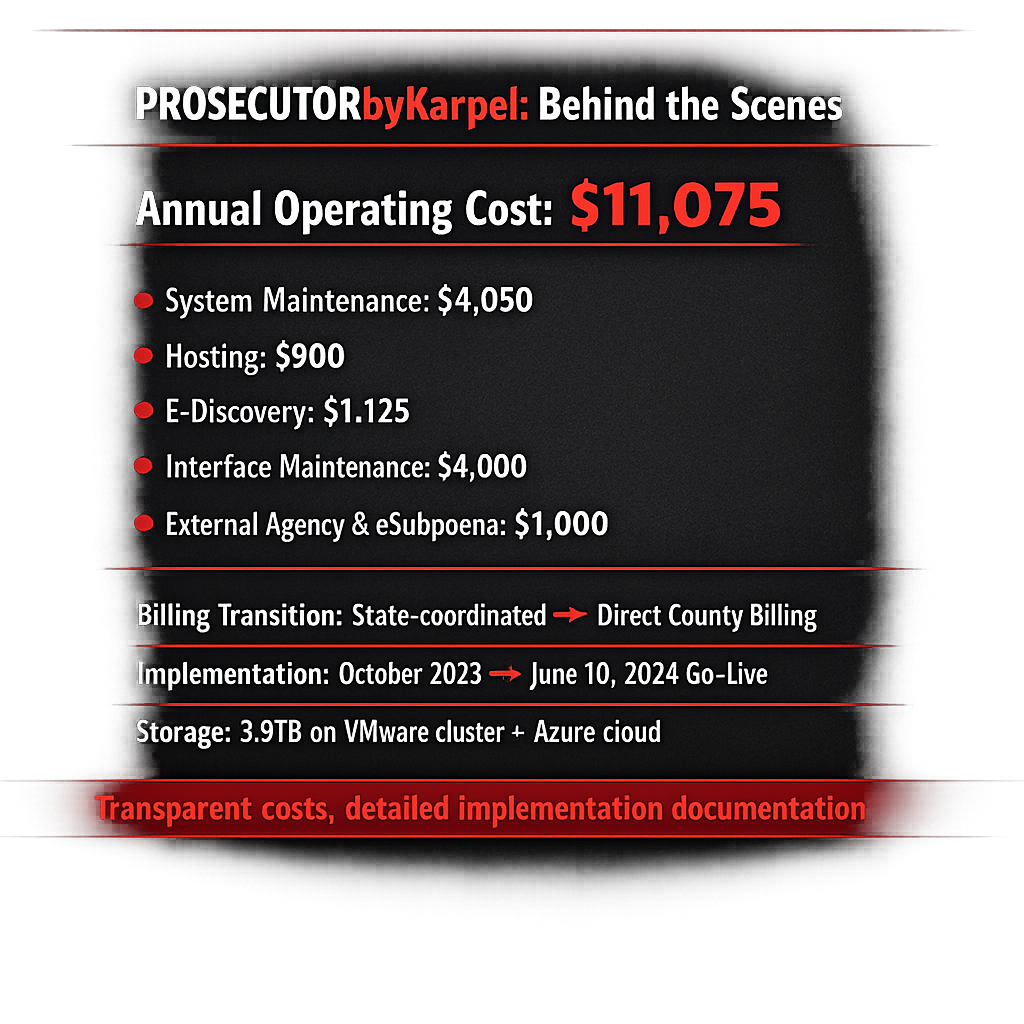
2. Annual Operating Costs: $11,075
The invoice establishes that Delta County’s annual cost for ProsecutorbyKarpel is $11,075. This breaks down as follows:
- System Maintenance ($4,050): The core software maintenance fee, billed monthly (9 months of coverage at $450/month)
- Hosting ($900): Annual hosting fee, also billed monthly (9 months at $100/month)
- E-Discovery ($1,125): Annual fee for electronic discovery capabilities, critical for modern prosecution
- Interface Maintenance ($4,000): Annual fees for maintaining integrations with:
- LEIN (Law Enforcement Information Network): $1,000
- VINE (Victim Information and Notification Everyday): $1,000
- MSP Lab: $2,000
- External Agency & eSubpoena ($1,000): Annual fee for capabilities related to external agencies and electronic subpoenas
The fact that maintenance and hosting are billed for 9 months rather than 12 is worth noting and may relate to the billing cycle or contract terms.
3. Implementation Timeline and Go-Live
The FOIA #26-44 communications reveal a detailed implementation timeline:
- October 17, 2023: Initial kickoff discussion, formal kickoff expected in mid-December 2023
- December 2023: Formal project kickoff
- February 2024: Data migration planning, Azure BLOB Storage configuration
- April-May 2024: Workstation setup and final preparations
- June 10, 2024: Go-Live date
The timeline included multiple data validation phases (at GL-150, GL-135, and GL-100 days before go-live), document template collection and coding, interface testing, and a mock go-live 30-60 days before the actual go-live date.
4. Technical Infrastructure Decisions
The communications reveal important technical infrastructure decisions:
Storage and Hosting:
- Total Storage Usage: 3.9TB (excluding video files)
- Infrastructure: VMware cluster with SAN (Storage Area Network) storage
- Location: Server room in the Courthouse
- Cloud Integration: Microsoft Azure BLOB Storage for data migration and storage
File Management:
- Decision to exclude certain file types from data migration: .avi, .iso, .exe, .mp4, and .wav files
- Primary focus on excluding video files due to their large size
- Nextcloud used as the self-hosted file sharing platform for project collaboration
5. Extensive Vendor Communication
The 156 pages of emails demonstrate extensive communication between Delta County and Karpel Solutions throughout the implementation process. This includes:
- Technical coordination and troubleshooting
- Scheduling and milestone management
- Document template collection and formatting
- Workstation configuration support
- Data migration planning and execution
This level of communication is typical for major software implementations and suggests active engagement from both Delta County IT staff and Karpel’s implementation team.
What We Don’t Know
Without the original FOIA request letters and response explanations, there are some limitations to what we can determine from these documents:
- What Was Requested: We don’t know what specific request led to these documents, so we can’t assess whether the response was complete or partial.
- What Was Denied: There’s no covering response letter explaining what, if anything, was denied or why.
- Context of Other Requests: We don’t know if other documents were requested but not provided.
- Relationship Between #26-44 and #26-46: It’s unclear whether these were separate FOIA requests or related parts of a single request.
Relationship to Other FOIA Requests
These documents are particularly valuable when viewed in context with other FOIA requests we’ve analyzed:
Connection to FOIA #26-75
As noted in our analysis of FOIA #26-75, that response referenced the January 27, 2026 invoice (from #26-46) as one of the documents provided. The #26-75 analysis used this invoice to establish that Delta County is now being billed directly for system costs.
Connection to FOIA #25-201
The PAAM contract provided in FOIA #25-201 specified the billing transition from PAAM to direct county billing after September 2026. The #26-46 invoice provides concrete evidence that this transition has occurred.
Connection to FOIA #25-202
FOIA #25-202 provided emails from October 2022 and March 2023 about the system selection process. FOIA #26-44 provides emails from October 2023 through May 2024 about the implementation process. Together, these tell the story from system selection through implementation and go-live.
Assessment: What This Tells Us
Positive Findings
- Transparent Cost Information: The invoice provides complete transparency about annual operating costs, with a detailed breakdown of each component.
- Detailed Implementation Documentation: The 156 pages of emails provide extensive documentation of how the system was implemented, what technical decisions were made, and how challenges were addressed.
- Evidence of Billing Transition: The invoice clearly documents the shift from PAAM-coordinated billing to direct county billing, which is a significant fiscal development.
- Technical Transparency: The communications show detailed technical discussions, suggesting no effort to hide how the system works or what infrastructure decisions were made.
Questions Raised
- 9-Month Billing Cycle: Why are maintenance and hosting billed for 9 months rather than 12? This may relate to the contract terms or billing cycle, but it’s unclear without additional context.
- Board of Commissioners Oversight: We still lack documentation about whether the Board of Commissioners was briefed on costs, funding sources, or the billing transition. As we noted in our FOIA #26-75 analysis, the Prosecutor’s Office stated no such documentation exists.
- Budget Impact: With annual costs of $11,075, what budget line item is funding these expenses? How was this budgeted for?
- Previous Years’ Costs: What were costs for Years 1-3 when PAAM was handling billing? Were those costs lower, higher, or the same?
- Future Cost Projections: Will costs remain stable at $11,075 annually, or are there scheduled increases? The contract allows for annual maintenance fee increases of up to 4%.
The Bigger Picture
These documents contribute to a growing picture of how Delta County implemented ProsecutorbyKarpel and what it costs to operate. We now know:
- Selection Process: FOIA #25-202 shows how Delta County selected ProsecutorbyKarpel from among multiple vendors
- Contract Terms: FOIA #25-201 shows the contractual arrangements and billing structure
- Implementation Process: FOIA #26-44 shows the day-to-day implementation work
- Current Costs: FOIA #26-46 shows the current annual operating costs and direct billing arrangement
What remains less clear is the oversight and budgeting process. We don’t have documentation of:
- Board of Commissioners briefings or approvals
- Internal budget planning for system costs
- How the billing transition was communicated to county leadership
- Whether there were any funding commitments from the state beyond the initial PAAM-coordinated period
Conclusion
FOIA #26-46 and #26-44 provide valuable documentation of ProsecutorbyKarpel’s implementation and operating costs. The invoice clearly establishes the transition to direct county billing and provides complete transparency about annual costs. The implementation emails show detailed technical work and extensive vendor coordination.
These documents demonstrate substantial transparency about the operational and financial aspects of ProsecutorbyKarpel. The detailed cost breakdown and extensive implementation communications suggest no effort to hide how the system works or what it costs.
However, the absence of documentation about Board of Commissioners oversight and internal budgeting processes – as noted in our FOIA #26-75 analysis – remains a concern. The public has a right to understand not just what a system costs, but how those costs are planned for, approved, and budgeted.
The transition from state-coordinated billing to direct county billing represents a significant fiscal change for Delta County. While the technical and operational implementation appears to have been handled transparently, the oversight and budgeting processes deserve greater scrutiny.
We’ll continue to seek documentation about how major technology expenditures like ProsecutorbyKarpel are planned, approved, and overseen by county leadership.
Leave a comment