FOIA #26-75: A Balanced Look at What Delta County Provided vs. What Was Requested
March 19, 2026 – When WickmanWatch submitted FOIA Request #26-75 on March 12, 2026, we sought comprehensive documentation about funding arrangements for the ProsecutorbyKarpel case management system. The Prosecutor’s Office responded six days later, providing some records while refusing to reproduce others they claimed were previously provided.
This analysis takes an honest, balanced look at what was requested, what was actually provided, and where significant gaps remain.
The Request: What We Asked For
FOIA #26-75 was a comprehensive request seeking to understand the funding structure for the ProsecutorbyKarpel system. Specifically, we requested:
Funding Commitment Documents: Contracts, agreements, and communications between the Delta County Prosecutor’s Office and the Prosecuting Attorneys Coordinating Council (PACC) regarding funding commitments, including which costs would be covered by PACC or the State of Michigan versus Delta County, and any references to promises that the project would be “fully funded.”
Invoice and Payment Documentation: Records showing whether invoices from Karpel Solutions were paid by Delta County, PACC, the State of Michigan, or other entities.
Contract and Billing Documents: The complete contract between Delta County and the Prosecuting Attorneys Association of Michigan (PAAM), all contracts and purchase orders with Karpel Solutions, and all invoices from January 1, 2023 to present.
Internal Documentation: Internal memoranda, emails, meeting minutes, budget documents, and any materials discussing funding commitments, state funding, billing discrepancies, or the “fully funded” promise.
Board Communications: Any presentations, memos, or reports provided to the Delta County Board of Commissioners regarding the system, including cost projections and funding sources.
The Response: What Was Actually Provided
The Prosecutor’s Office responded on March 19, 2026, providing nine responsive email communications while refusing to reproduce several other records based on a previous FOIA precedent.
What They Provided
The response included nine email communications dated between July 2023 and February 2026. These emails appear to relate to the ProsecutorbyKarpel system implementation and ongoing operational matters.
Additionally, they provided one invoice from Karpel Solutions dated January 27, 2026, for $11,075.00 covering annual maintenance fees for various system components including hosting, e-discovery services, and interface maintenance with LEIN, VINE, and MSP Lab systems.
What They Refused to Reproduce
The Prosecutor’s Office refused to provide three categories of records, citing the precedent of Densmore v. Department of Corrections, 203 Mich. 363 (1994):
- The PAAM-Delta County Contract – They stated this was previously provided in response to FOIA Request #25-201
- Emails from October 2022 and March 2023 – They stated these were previously provided in response to FOIA Request #25-202
- Invoices attached to those emails
As we discussed in our previous analysis of FOIA #26-56, the use of Densmore to justify refusing to reproduce previously provided records is legally questionable. However, for purposes of this balanced analysis, we’ve reviewed what was actually provided in those previous requests to assess whether the substantive information was truly available.
What They Denied as Non-Existent
The response also denied several categories of records as non-existent:
- Reimbursement requests or vouchers (Paragraphs II(4) and II(5)): They stated “There have been no reimbursement requests or vouchers, as the invoices have been paid directly by PAAM”
- Internal budget documents (Paragraph IV(10)): They stated records do not exist and that Delta County has not expended funds for the system
- Board of Commissioners documentation (Paragraph VI(14)): They stated no such records exist
Cross-Reference Analysis: What Was Actually in Previous FOIAs
To provide a fair assessment, we reviewed the records that were actually provided in the previously referenced FOIA requests.
FOIA #25-201: The PAAM Contract
The contract between the Prosecuting Attorneys Association of Michigan (PAAM) and Delta County Prosecutor’s Office does contain significant information about the funding structure:
Key Findings:
- PAAM serves as the “central billing entity” until September 30, 2026, after which each county will be billed individually
- The contract explicitly states: “PAAM has agreed to be the central billing entity until September 30, 2026. After that date each client will be billed individually.”
- PAAM reserves the right to make contract payments to Karpel Solutions through electronic funds transfer
- Maintenance and support fees may be adjusted annually by up to 4%
- Additional work requirements outside the contract scope must be approved and paid for by the individual client
- Travel expenses and certain other costs are explicitly the client’s responsibility, not PAAM’s
Assessment: The contract does provide substantial information about the funding structure and cost allocation. It clearly establishes that PAAM was handling billing initially, with a transition to direct county billing after September 2026. This directly addresses part of what we requested regarding cost responsibilities.
FOIA #25-202: System Selection Emails
This request produced emails from October 2022 and March 2023, which the Prosecutor’s Office described as being about “the process of ‘picking’ the system.”
Key Findings:
- These emails relate to the ACT/JCT replacement system selection process
- They include discussions of demos from multiple vendors (LawBase/OnBase, Karpel, and Equivant)
- They involve voting procedures for system selection
- They are administrative communications about evaluating and choosing a system
Assessment: These emails do not appear to contain information about funding commitments, cost allocations, or promises that the project would be “fully funded.” They’re about system selection, not financing. While they’re relevant context for understanding how Delta County ended up with ProsecutorbyKarpel, they don’t address the funding questions at the heart of FOIA #26-75.
FOIA #26-46: January 2026 Invoice
This request produced a single invoice from Karpel Solutions dated January 27, 2026.
Key Findings:
- The invoice is addressed to “Delta County Prosecutor’s Office” (not PAAM)
- It bills for “Delta Year 4 Annual Billing: June 2027- May 2028”
- The total amount is $11,075.00
- Payment terms are “Net 30 days”
Assessment: This invoice is significant because it’s addressed directly to Delta County, not PAAM. This aligns with the contract’s provision that individual counties would be billed individually after September 2026. However, this raises an important question: if Delta County is now being billed directly for Year 4, who paid for Years 1-3, and were those payments made by PAAM as the contract indicates?
Gaps and Concerns: What’s Missing
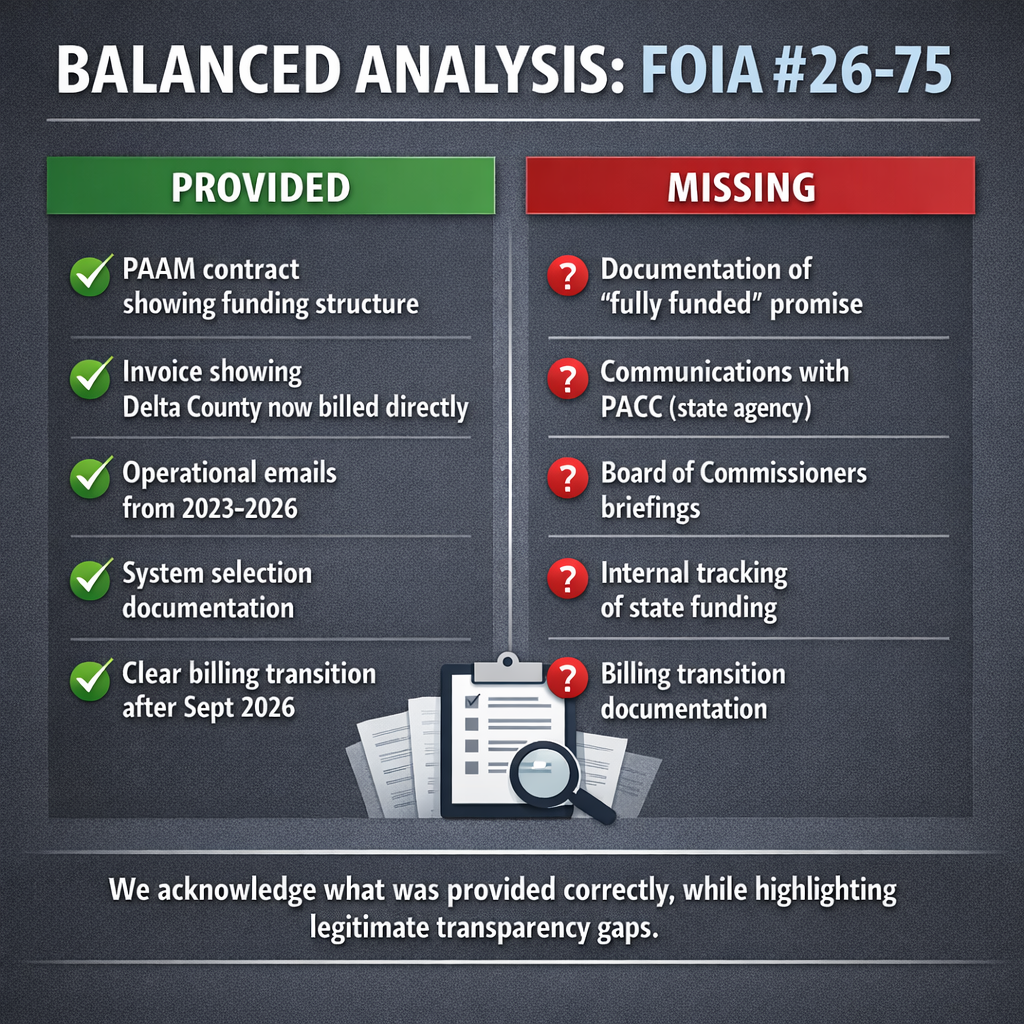
Based on our cross-reference analysis, several significant gaps remain between what was requested and what was actually provided (or previously available).
1. The “Fully Funded” Promise
Our request specifically sought communications referencing “the promise or commitment that the project would be ‘fully funded'” by PACC or the State of Michigan. None of the provided emails or previously provided records contain any reference to such a promise.
Why This Matters: If there was a representation that the project would be “fully funded” by the state, that would be material information for county commissioners and the public. The absence of any documentation of this promise – or clarification that no such promise was made – is a significant gap.
2. PACC vs. PAAM Communications
Our request specifically sought communications with the Prosecuting Attorneys Coordinating Council (PACC). However, most of the documentation we’ve seen relates to PAAM (Prosecuting Attorneys Association of Michigan). While these organizations are related, they are distinct entities.
Why This Matters: PACC is a state agency, while PAAM is a professional association. If funding commitments were made by PACC (a state entity), that would be different from arrangements made through PAAM. The absence of PACC-specific communications is concerning.
3. Internal Tracking of State Funding
The Prosecutor’s Office denied the existence of internal budget documents, stating that Delta County hasn’t expended any funds for the system. However, this raises a practical question: if the state (through PAAM) was paying for the system, did Delta County maintain any internal documentation of those funding commitments?
Why This Matters: Even if Delta County didn’t write checks directly, responsible fiscal management would typically involve some form of tracking or documentation of external funding commitments. The complete absence of any internal documentation is puzzling.
4. Board of Commissioners Documentation
The response states that no presentations, memos, reports, or cost projections were provided to the Board of Commissioners regarding the ProsecutorbyKarpel system.
Why This Matters: This is surprising. When a county implements a major new case management system, particularly one involving state funding, it’s standard practice to brief the Board of Commissioners on costs, implementation, and funding sources. The absence of any such documentation raises questions about oversight and transparency.
5. Documentation of Billing Transitions
While the contract indicates PAAM was the central billing entity until September 2026, and we now see an invoice addressed directly to Delta County for Year 4, there’s a gap in documentation about how and when this transition occurred.
Why This Matters: Understanding the transition from state-coordinated billing to direct county billing is essential for understanding the full cost implications for Delta County taxpayers.
Assessment: What They Got Right
In the interest of providing a balanced analysis, it’s important to acknowledge what the Prosecutor’s Office did provide correctly:
-
The Contract Was Available: The PAAM contract was indeed previously provided and contains substantive information about the funding structure.
-
The January 2026 Invoice Was Provided: This gives us concrete information about current direct billing to Delta County.
-
The Selection Process Emails Were Available: While they don’t address funding, they do provide context about how Delta County ended up with the ProsecutorbyKarpel system.
-
Additional Communications Were Provided: The response included nine emails from July 2023 to February 2026 that weren’t referenced in previous requests, which may contain relevant operational information.
Assessment: What Raises Concerns
However, several aspects of this response are problematic:
-
Questionable Use of Densmore Precedent: As we noted in our analysis of FOIA #26-56, using Densmore v. Department of Corrections to justify refusing to reproduce previously provided records is legally questionable. Each FOIA request is independent, and public records don’t become “closed” after one disclosure.
-
Missing “Fully Funded” Documentation: The specific request for documentation of a “fully funded” promise appears to have been completely unaddressed. Either such documentation exists and wasn’t provided, or it doesn’t exist – but the response doesn’t clarify which.
-
No PACC-Specific Communications: The request specifically sought PACC communications, but the response focused on PAAM materials. These are different entities, and the distinction matters for understanding state vs. association funding.
-
Implausible Absence of Board Documentation: The claim that no documentation was provided to the Board of Commissioners about a major system implementation strains credibility. Major technology implementations typically require Board awareness and approval.
-
No Internal Tracking of External Funding: The complete absence of any internal documentation tracking state funding commitments, even if Delta County didn’t pay directly, suggests poor record-keeping or incomplete responses.
-
Gap in Billing Transition Documentation: The shift from PAAM billing to direct Delta County billing between the contract terms and the January 2026 invoice is not documented.
The Bigger Picture
This FOIA request was about transparency in government technology funding. The questions we asked – who’s paying for ProsecutorbyKarpel, what were the funding commitments, and how are costs being allocated – are fundamental questions of fiscal responsibility.
What we’ve learned from the provided documents is:
- PAAM was established as the central billing entity through September 2026
- Delta County is now being billed directly for system costs
- The system selection process involved multiple vendor demos and voting
- Current annual costs for maintenance and services are approximately $11,075
What we still don’t know includes:
- Whether there was ever a promise or representation that the project would be “fully funded” by the state
- What communications, if any, occurred with PACC (the state agency) regarding funding
- Whether the Board of Commissioners was informed about costs and funding sources
- How the transition from state-coordinated to direct billing was handled
- What internal tracking, if any, exists of state funding commitments
Conclusion
This FOIA response demonstrates both cooperation and resistance from the Delta County Prosecutor’s Office. They did provide substantive documentation, including the key contract and recent invoice. However, they also refused to reproduce previously provided records using questionable legal precedent, and several critical questions remain unanswered.
The most significant concern is the absence of any documentation about a “fully funded” promise. Our request specifically sought this information, and the response provides neither confirmation nor denial of whether such documentation exists. This is a material gap in transparency.
Additionally, the complete absence of any documentation provided to the Board of Commissioners raises questions about oversight. If Delta County is now paying directly for this system, the Board and the public have a right to understand the full cost history and funding commitments.
We’re not suggesting impropriety – it’s entirely possible that the state funding arrangements were handled through PAAM as the contract indicates, and that no separate “fully funded” promise was ever made. But without access to the relevant documentation, the public cannot make an informed assessment.
Government transparency requires more than providing some records while refusing others. It requires a good-faith effort to ensure the public has access to the information needed to understand how public funds are being spent and how public services are being funded.
In this case, while some information was provided, critical gaps remain that prevent a complete understanding of the funding arrangements for the ProsecutorbyKarpel system.
Leave a comment