Lab Results Confirm Cocaine in Escanaba Bar Raid: 26.4 Grams Seized in Traffic Stop
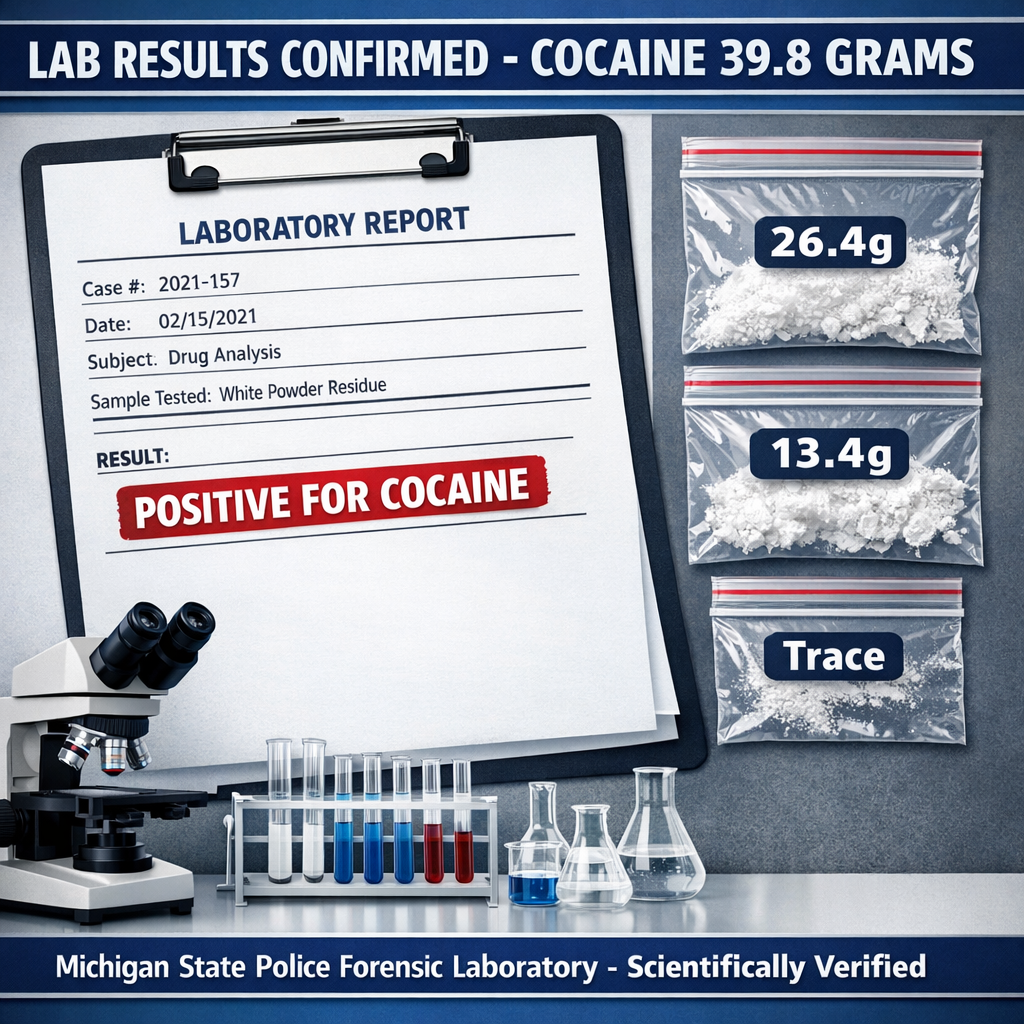
Laboratory testing results from the Escanaba bar cocaine raid confirm the presence of cocaine in multiple evidence items, including a substantial 26.4-gram sample seized during a traffic stop, according to forensic analysis documents obtained through FOIA Request #25-234.
The laboratory reports provide scientific confirmation of the controlled substances that formed the basis for successful prosecution in the case.
View the responsive documents. They are split into two parts. FOIA _25-234 – Lab Results from Escanaba Bar Cocaine Raid_1. and FOIA _25-234 – Lab Results from Escanaba Bar Cocaine Raid_2
What Was Requested
On October 1, 2025, I submitted a FOIA request seeking:
“Copies of laboratory testing results related to the evidence seized in the Escanaba bar cocaine raid, which was the subject of my prior FOIA request #25-130.”
Specifically, I requested:
- Laboratory analysis reports, toxicology results, or controlled substance testing reports from the Michigan State Police Forensic Laboratory or other forensic laboratories concerning suspected narcotics seized
- Any chain-of-custody cover sheets accompanying those lab results
- Any transmittal or return correspondence between the Prosecutor’s Office and the laboratory regarding the status or outcome of testing
What Was Provided
Granted: Laboratory Reports
The Prosecutor’s Office GRANTED the request for laboratory analysis reports and provided four forensic laboratory reports from the Michigan State Police Forensic Science Division in Marquette:
Report 1: March 4, 2024 – Item #14 (Trash Pull)
Laboratory Report MQ 24-101, Record Number 1
- Date Released: March 4, 2024
- Investigating Officer: Josh Dishaw (Michigan Department of State Police)
- Agency No.: UPT-19-24
- Evidence: Agency Item #14, seized from trash pull on January 31, 2024
- Item Tested: Plastic bag corner with faint white residue
Results:
- Substance Identified: Cocaine
- Schedule: Not specified in provided document
- Additional Information: Item was transferred to the Latent Print Unit for additional examinations
Analyst: Sara Kozmor, Forensic Scientist, Controlled Substances Unit
This report confirms that the residue found during a trash pull investigation was indeed cocaine, providing scientific evidence for the case.
Report 2: March 12, 2024 – Latent Print Testing (Item #14)
Laboratory Report MQ 24-101, Record Number 2
- Date Completed: March 12, 2024
- Investigating Officer: Josh Dishaw
- Agency No.: UPT-19-24
- Evidence: Agency Item #14 (same item as Report 1)
- Testing: Latent print processing
Results:
- Latent Prints: “There were latent prints of no comparison value on Item #1”
- Significance: The presence of latent prints indicates contact, but the prints recovered were not suitable for identification purposes
Analyst: Ryan P. Gerbig, SpUSgt, Michigan State Police Specialist, Latent Print Unit
This report shows that forensic investigators attempted to identify fingerprints on the drug packaging but were unable to recover prints suitable for comparison.
Report 3: February 3, 2025 – Item #18 (Traffic Stop – 13.4 Grams)
Laboratory Report MQ 24-101, Record Number 3
- Date Received: January 31, 2025
- Date Released: February 3, 2025
- Investigating Officer: James McDonough (Michigan Department of State Police)
- Agency No.: UPT-19-24
- Evidence: Agency Item #18, turned over to UPSET following traffic stop by Delta County Sheriff’s Office
- Related Reports: UPT Report 19-24, Supplement 4, and Delta County Sheriff’s Department Report Number 24-813
- Item Tested: Heat sealed bag containing chunky white powder material
Results:
- Substance Identified: Cocaine
- Schedule: Not specified
- Weight: 13.4 grams
- Additional Information: Results relate only to items tested
Analyst: Sara Kozmor, Forensic Scientist, Seized Drug Unit
This report confirms that 13.4 grams of cocaine was seized during a traffic stop and turned over to UPSET investigators.
Report 4: February 6, 2025 – Item #20 (Traffic Stop – 26.4 Grams)
Laboratory Report MQ 24-101, Record Number 4
- Date Received: February 6, 2025
- Date Released: February 6, 2025
- Investigating Officer: James McDonough
- Agency No.: UPT-19-24
- Evidence: Agency Item #20, turned over to UPSET following traffic stop by Delta County Sheriff’s Office
- Related Reports: UPT Report 19-24, Supplement 4, and Delta County Sheriff’s Department Report Number 24-813
- Item Tested: Heat sealed plastic bag containing chunky white powder material
Results:
- Substance Identified: Cocaine
- Schedule: 1
- Weight: 26.4 grams
- Additional Information: Results relate only to items tested
Analyst: Sara Kozmor, Forensic Scientist, Seized Drug Unit
This report confirms the seizure of the largest single quantity in the case—26.4 grams of cocaine—from a traffic stop.
Denied: Chain-of-Custody Cover Sheets
The request for “any chain-of-custody cover sheets accompanying those lab results” was DENIED with the explanation:
“A review of the records reveal they do not exist over and above the cover sheets referenced and provided above for each individual lab report.”
The Prosecutor’s Office explained that:
- The investigation was primarily conducted by UPSET with assistance from other agencies
- All evidence initially seized by the Delta County Sheriff’s Office was immediately turned over to UPSET
- The Prosecutor’s Office does not maintain or possess any chain-of-custody cover sheets outside of the cover sheets referenced above
- References to evidence transfer are documented in DCSO Report 24-813 and UPT Report 19-24
Denied: Transmittal/Return Correspondence
The request for “any transmittal or return correspondence between the Prosecutor’s Office and the laboratory regarding the status or outcome of the testing” was DENIED with the explanation:
“A review of the records reveal they do not exist.”
The Prosecutor’s Office certified that after a search for records, the requested correspondence documents do not exist within the records of the public body.
What This Means
Scientific Confirmation of Drug Seizures
The laboratory reports provide definitive scientific confirmation that:
- Cocaine was present in all tested items
- The seizures were legitimate and formed the basis for criminal charges
- The evidence was properly handled and tested by accredited forensic laboratories
Total Quantity Confirmed
From the laboratory reports, we can confirm:
- Item #14: Trace residue (cocaine confirmed)
- Item #18: 13.4 grams of cocaine
- Item #20: 26.4 grams of cocaine
- Total Confirmed: 39.8 grams of cocaine (approximately 1.4 ounces)
This total is significantly less than the approximately 4 ounces (approximately 113 grams) originally reported, though it’s possible that:
- Additional evidence was not tested or was tested separately
- The original estimate included other seized substances (paraphernalia, prescription medications)
- The reports provided do not represent all evidence seized
Timeline of Evidence Collection
The laboratory reports reveal an interesting timeline:
- January 31, 2024: Trash pull conducted, Item #14 seized
- March 4, 2024: Laboratory confirms Item #14 is cocaine
- March 12, 2024: Latent print testing completed (no usable prints)
- January 31, 2025: Item #18 received by laboratory (11 months later)
- February 3, 2025: Laboratory confirms Item #18 is 13.4 grams of cocaine
- February 6, 2025: Laboratory confirms Item #20 is 26.4 grams of cocaine
The 11-month gap between the trash pull and the traffic stop evidence suggests this was an ongoing investigation rather than a single incident.
Forensic Quality Standards
All laboratory reports include certification that:
- The MSP Laboratory is accredited to the ISO 17025:2017 standard
- The laboratory meets AR 3125 supplemental standards for testing laboratories
- Accreditation was granted by ANAB since March 3, 2021
- Analysts are qualified by education, training, and experience
This confirms that the evidence was tested by properly accredited laboratories using scientifically validated methods.
Latent Print Limitations
The latent print report demonstrates the challenges of fingerprint evidence:
- Residue on drug packaging is removed and destroyed prior to latent print processing
- Recovery of latent prints on evidence items is not always successful
- Lack of latent prints does not necessarily mean a person didn’t contact the item
- The presence of latent prints alone does not indicate significance or timing of contact
Why This Matters
Scientific Validation of Prosecution
The laboratory reports provide the scientific foundation for the successful prosecution documented in FOIA #25-130:
- Confirms the substances were actually cocaine
- Provides exact weights for evidence
- Demonstrates proper forensic procedures were followed
- Shows evidence was tested by accredited laboratories
Transparency in Evidence Handling
The Prosecutor’s Office’s response demonstrates transparency by:
- Providing complete laboratory reports
- Including analyst information and credentials
- Explaining why certain documents (chain-of-custody, correspondence) don’t exist
- Providing context about evidence transfer between agencies
Understanding Evidence Gaps
The denied requests for chain-of-custody documents and correspondence raise questions:
- Why doesn’t the Prosecutor’s Office maintain chain-of-custody documentation?
- How is evidence tracked between agencies without formal documentation?
- What correspondence procedures exist between the Prosecutor’s Office and forensic laboratories?
Forensic Laboratory Timeline
The timeline reveals potential efficiency concerns:
- 11-month gap between initial trash pull and traffic stop evidence testing
- Items #18 and #20 received in January/February 2025, tested quickly
- Item #14 tested within weeks of seizure
- Different timelines for different evidence items
What Should Exist
Chain-of-Custody Documentation
While the Prosecutor’s Office states chain-of-custody cover sheets don’t exist “over and above” the cover sheets provided with lab reports, standard evidence handling practices typically include:
- Detailed chain-of-custody logs tracking every person who handled evidence
- Transfer documentation when evidence moves between agencies
- Receipt documentation when evidence is received from law enforcement
- Inventory documentation when evidence is submitted to laboratories
The absence of these documents raises questions about evidence tracking procedures.
Prosecutor-Laboratory Communication
The denial of correspondence documents suggests:
- Communication may be handled informally
- Status updates may be provided through other channels
- The Prosecutor’s Office may not maintain written records of laboratory communications
- There may be efficiency improvements possible in documentation practices
Comparison with Original FOIA #25-130
The laboratory results provide context for the sentencing information obtained in FOIA #25-130:
From FOIA #25-130:
- Defendant James Joseph Johnson sentenced to 38 months minimum, 15 years 9 months maximum for cocaine delivery
- Total reported seizure: approximately 4 ounces of cocaine
From FOIA #25-234:
- Laboratory confirmed: 39.8 grams of cocaine across three items
- Largest single item: 26.4 grams
- Timeline: January 2024 to February 2025
The laboratory-confirmed weight (39.8 grams, approximately 1.4 ounces) is significantly less than the originally reported 4 ounces, though it’s possible the original estimate included other substances or unreported evidence.
Questions Remaining
- Quantity Discrepancy: Why do the laboratory results show 39.8 grams when the original report stated approximately 4 ounces (113 grams)?
- Additional Evidence: Were there other items seized that were not tested or were tested separately?
- Chain of Custody: How is evidence tracked between agencies without formal chain-of-custody documentation?
- Communication Procedures: What procedures exist for communication between the Prosecutor’s Office and forensic laboratories?
- Testing Priorities: Why was there an 11-month gap between testing of different evidence items?
Conclusion
FOIA Request #25-234 successfully obtained laboratory testing results that scientifically confirm the presence of cocaine in evidence seized during the Escanaba bar investigation. The forensic reports provide definitive confirmation that:
- Cocaine was present in all tested items
- Substantial quantities were seized (13.4 grams and 26.4 grams in separate items)
- Evidence was tested by accredited forensic laboratories
- Proper scientific procedures were followed
The Prosecutor’s Office demonstrated transparency by providing complete laboratory reports and explaining the absence of chain-of-custody and correspondence documents.
However, the discrepancy between laboratory-confirmed quantities (39.8 grams) and originally reported quantities (approximately 4 ounces), along with questions about evidence tracking and communication procedures, warrants further examination.
The laboratory reports provide the scientific foundation for the successful prosecution of James Joseph Johnson, who received a significant prison sentence based on this evidence. The confirmation of cocaine through forensic testing validates the law enforcement actions and prosecutorial decisions in this case.
Related Documents:
- FOIA Request #25-234 (October 1, 2025)
- Response dated October 8, 2025
- Laboratory Report MQ 24-101, Record 1 (March 4, 2024)
- Laboratory Report MQ 24-101, Record 2 (March 12, 2024)
- Laboratory Report MQ 24-101, Record 3 (February 3, 2025)
- Laboratory Report MQ 24-101, Record 4 (February 6, 2025)
- Related to FOIA #25-130 (case sentencing information)
Key Statistics:
- Laboratory Confirmed Cocaine: 39.8 grams total
- Largest Single Item: 26.4 grams (Item #20)
- Second Largest Item: 13.4 grams (Item #18)
- Trace Residue: Item #14 (cocaine confirmed)
- Testing Timeline: January 2024 to February 2025
- Laboratory: Michigan State Police Forensic Science Division, Marquette
- Accreditation: ISO 17025:2017 standard, AR 3125 supplemental standards
Tags: FOIA, Laboratory Results, Cocaine, Forensic Evidence, UPSET, Delta County, Prosecutor’s Office, Drug Seizure, Scientific Testing
Leave a comment